

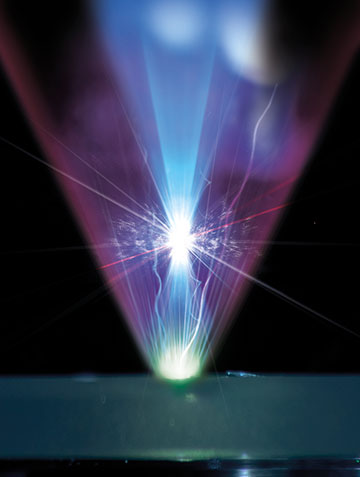
This combination of photograph and artist's impression shows the creation of an exceptionally intense reflected beam (purple) via a coherent harmonic focus. [Image: Timmis et al. 2026]
By precisely tailoring the shape of light pulses used to create relativistic plasmas, a group led by UK-based physicists has shown it should be possible to boost the intensity of ultra-powerful lasers by many orders of magnitude (Nature, doi: 10.1038/s41586-026-10400-2). They reckon that the breakthrough could potentially allow upcoming petawatt laser facilities to reach intensities high enough to “break the vacuum.”
Stronger lasers
Since the laser was invented in 1960, a series of technological advances has yielded ever more powerful and intense beams. The realization of chirped pulse amplification in particular has led to laser systems that can generate powers in excess of 1 petawatt (PW; 1015 W) and intensities of around 1022 Wcm-2. By raising the latter figure about another seven orders of magnitude, theory predicts that a laser ought to have the field strength to break apart electrons and positrons that form spontaneously from the quantum vacuum.
One way to try and achieve these conditions is to fire an already intense laser at a suitable solid target, turning the target into a plasma and causing its electrons to oscillate coherently at close to the speed of light. This produces a reflected beam containing many harmonics of the driving frequency, which leads to a smaller diffraction-limited focal spot (thanks to the shorter wavelengths involved) and the formation of intensity spikes far shorter than the period of the incoming radiation. The combined effect of this spatial and temporal compression, which results in a “coherent harmonic focus” (CHF), should multiply the light intensity many tens of times over.
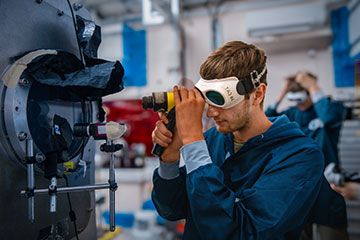
Colm Fitzpatrick, Queens University, Belfast, UK, uses an infrared viewer to observe the laser beam in the target chamber. [Image: Helen Towrie]
Researchers have already demonstrated such compression, but they have not done so efficiently. Ideally, the efficiency of converting energy from an incoming to outgoing beam should drop off fairly slowly with increasing harmonic order, so that all orders contribute meaningfully to the field of the reflected pulse. This relies on a very steep density gradient across the plasma electrons, which in turn requires very short-pulsed beams. Modern petawatt-class lasers can generate pulses less than 50 femtoseconds (fs; 10-15 s) long but lack the pulse-shaping precision needed to optimize the plasma’s density profile on such short timescales.
Just-right pulses
Peter Norreys and Robin Timmis at the University of Oxford, Brendan Dromey and Mark Yeung at Queens University Belfast, alongside colleagues in the United Kingdom, United States and Germany, have shown how to create pulses with just the right shape by exploiting what is known as a double plasma mirror. They bounce pulses off silica substrates that initially have low reflectivity but become highly reflective plasmas when subjected to sufficiently high intensities. This allows them to vary the rise time—during which the intensity of the main pulse shoots up by a factor of a million—and with it the main target’s plasma density profile. They then use a secondary, low-intensity laser pulse to finely tune the plasma conditions.
They carried out the work using the Gemini laser at the Rutherford Appleton Laboratory, UK. Originally, they used a mirror with an anti-reflection coating to generate inbound pulses of around 1021 Wcm-2 with a rise time of around 700 fs, resulting in higher harmonics whose field strengths quickly decayed. But by replacing the mirror with an uncoated substrate, they obtained pulses with half the rise time (and a similar intensity). This produced dozens of slowly decaying harmonics that matched the simulated output from an optimized experiment, yielding an overall conversion efficiency of nearly 20%.
The researchers were not able to measure the intensity of the reflected pulse directly, since, as Norreys explains, the CHF is achieved by summing the electric fields of all harmonic orders in their diffraction limit, which in the case of higher orders are nanometer (or smaller) in diameter. To get around this problem, the researchers instead used computer simulations to model the Gemini laser pulse interacting with the plasma in two dimensions before extrapolating the result to three dimensions. They concluded that the reflected intensity was greater than 1023 Wcm-2, which, the team says, would represent the most intense burst of coherent light ever made.
Toward vacuum-shattering intensities
Norreys and colleagues believe that applying this technique to lasers currently under construction—such as the 20-PW Vulcan 20-20 facility in the United Kingtom or the 50-PW Station of Extreme Light in China—could, under the right experimental conditions, yield the 1029 Wcm-2 needed to break the vacuum. “The preconditions are now met to investigate the extreme intensity regime that is predicted to be possible using CHF,” they say.
Before that can happen, however, they caution that petawatt laser facilities will need to be updated. Vacuum-shattering intensities, they say, will require better control over plasmas in the form of higher intensity contrasts, faster rise times and tuneable density gradients. They add that a number of approximations they made in their simulations will also have to remain valid.
