

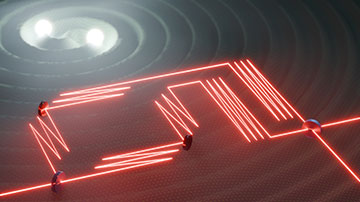
A proposed experiment for detecting gravitons combines the geometry of a normal interferometer with an additional stage that extends the optical path length by an order of magnitude. [Image: B. Schröder/HZDR]
Gravitational waves, tiny distortions in spacetime that travel at the speed of light, were predicted by Einstein over a century ago but eluded direct detection until the pioneering experiments at the Laser Interferometer Gravitational-Wave Observatory (LIGO), USA, in 2015. Ralf Schützhold, a theoretical physicist at the Helmholtz-Zentrum Dresden-Rossendorf (HZDR) in Germany, has now conceived a new experiment that would enable gravitational waves to be manipulated as well as observed, potentially offering new ways to probe the quantum nature of gravity (Phys. Rev. Lett., doi: 10.1103/xd97-c6d7).
Shifting energies
Schützhold’s idea is to exploit the interactions between a gravitational wave and the light pulses traveling within a large-scale interferometer. The exchange of tiny amounts of energy between the two could indicate the absorption or emission of “gravitons,” the fundamental quanta of the gravitational field that have been postulated by theorists but not yet proven.
His experimental scheme is based on a similar geometry to existing gravitational interferometers, which split laser light into two pulses that travel perpendicular to each other. A passing gravitational wave stretches the optical length in one direction while squeezing it in the other, creating a phase shift that can be measured at the detector.
In this new study, Schützhold shows that an energy exchange mediated by gravitons would shift the energies of the two pulses by an equal and opposite amount. To convert this tiny energy difference into a measurable phase shift, he proposes the addition of a second experimental stage that would reflect the modulated light pulses many times along the same path. This additional step would increase the optical path length to around a million kilometers, compared with 1000 km for LIGO, providing enough time for the phase difference to accumulate.
Major challenges
Based on the capabilities of present-day technology, Schützhold estimates that this approach would produce a measurable phase difference of 10–7. However, creating this modified experimental setup would present a major engineering challenge, in particular to maintain the optical stability within the long second stage. “It can take several decades to go from the initial idea to an experiment,” he comments.
If an upgraded interferometer were able to measure these phase differences, it would provide strong evidence for the existence of gravitons but not conclusive proof. In contrast, the lack of a phase difference in the presence of a gravitational wave would pose a significant challenge to the graviton hypothesis.
According to Schützhold, even more fundamental insights could be achieved by preparing the photons in highly entangled states, which in turn would generate a quantum superposition of gravitational waves with different energies. “Then we could even draw inferences about the quantum state of the gravitational field itself,” he says.
