

[Image: Felix Fricke]
In an impressive feat of engineering, two independent scientific teams—one in the Netherlands (Phys. Rev. Lett., doi: 10.1103/PhysRevLett.116.147202) and one in Canada (Phys. Rev. X, doi: 10.1103/PhysRevX.6.021001)—have demonstrated novel, nanogram-scale mechanical resonators with very high quality factors and low force noise. The resonators—hundred-micron-square, nanometer-thin patches of silicon nitride, suspended in a state of high tension via tiny guy wires, like trampolines—could, in the view of the teams, be well suited for classical mechanical sensing applications, and also as a platform for room-temperature experiments in quantum optomechanics.
Reducing force noise
While nanofabrication advances have already led to exquisitely sensitive mechanical resonators, one disadvantage has been that, for optomechanical experiments in particular, these systems must be chilled to cryogenic temperatures. That’s because, at room temperature, thermally driven force noise in such a system can gum up experiments in the single-photon or quantum realm.
The force noise can be reduced, however, by nudging several other parameters besides temperature. Decreasing the mass of the resonator, for example, will reduce the force noise density. So will increasing the resonator’s mechanical quality factor, which is related to the material’s stiffness, or spring constant, and is measured by the resonator’s “ring-down time”—the time it takes for vibrations at its resonance frequency to reach 1/e times their initial amplitude. The longer the ring-down time, the higher the implied mechanical quality factor and the lower the force noise.
Tiny trampolines in tension
To get to such ultralow-noise resonators, the two teams both turned to a material, silicon nitride (Si3N4), that had already shown some success in creating high-quality nanomechanical oscillators, and used clever design and fabrication techniques to push those systems still further. In both cases, the design consists of a thin patch of Si3N4 approximately 100 microns square and less than 100 nm thick, suspended on four Si3N4 “tethers.” Fabrication involves using lithography to create a resist mask in the appropriate shape, which is placed atop a layer of Si3N4 deposited on a silicon wafer and then used as a pattern to etch out the device shape in the overlying Si3N4.
The result is a tiny, spring-like resonator patch, held in high tension by the four tethers; indeed, the tensile stress concentration increases as the device thickness decreases. The Canada team reported that its mechanical resonator—which had an “effective spring constant” of approximately one N/m—sported ring-down times of longer than five minutes and a force noise of below 20 aN/Hz½ at room temperature. Because of its very low mass and low mechanical dissipation, displacements in the resonator are large enough to easily be read out with a laser in classical sensing applications. The team also showed that its device is compatible with precision interferometry and optomechanics applications.
Adding a photonic crystal
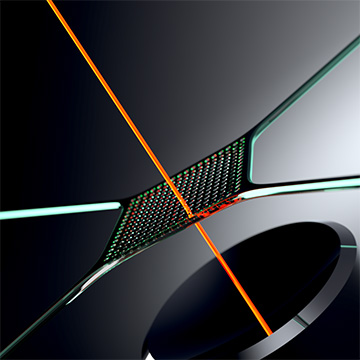
The Netherlands team pushed the design still further by patterning a photonic crystal on the surface of its nano-trampoline, which was engineered to be in a state of tension “near the ultimate yield strength” of Si3N4. The team observed that the crystal mirrors they fabricated could achieve reflectivities as high as 99 percent, while maintaining the resonator’s ultrahigh mechanical quality factor.
The combination, they said, means that laser cooling, rather than bulk cryogenic cooling, can be used to bring the resonator down its quantum ground state—which, in turn, could open up “fundamental tests of quantum physics” in situations “where complicated cryogenic setups are not feasible.” They also suggest that getting to such a low level of mechanical dissipation in an on-chip design “heralds a realistic building block” toward room-temperature, optically linked silicon-based quantum networks.
