

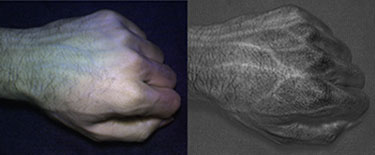
Compared to an image taken with a normal camera (left), HyperCam images (right) reveal detailed vein and skin texture patterns that are unique to each individual. Credit: University of Washington
Hyperspectral imaging—the high-resolution combination of imaging and spectroscopy that reveals details the human eye cannot see otherwise—holds great promise for such diverse applications as law enforcement and food inspection. The race is on to build smaller, more affordable systems and to process the flood of complex data that they generate.
Scientists at the University of Washington and Microsoft Research (USA) have devised a low-cost approach to hyperspectral imaging that incorporates a commercially available, cube-shaped digital camera 3 cm on a side with a set of 17 light-emitting diodes (LEDs) operating at carefully chosen wavelengths. As the group's lead author, Washington doctoral candidate Mayank Goel, described in a talk at the recent UbiComp conference in Osaka, Japan, the scheme also uses a software ranking scheme to zoom in on the imaging wavelength bands that are the most different from the red-green-blue (RGB) view of the unaided human eye.
The complementary metal-oxide semiconductor (CMOS) camera that the researchers chose for their system, dubbed HyperCam, has a sensitivity range of 350 to 1,080 nm and a maximum resolution of 1,280 x 1,024, and it typically sells for less than US$1,000. For illumination, the team built a circle of 17 narrow-band, off-the-shelf LEDs, which shine into the center of a white plastic “integrating sphere,” which then reflects the mixed-wavelength light toward the imaging subject. Future researchers can choose the wavelengths of the LEDs best suited to their experiments; the Washington team picked LEDs operating between 450 and 990 nm. The camera had a maximum frame rate of 150 frames per second (fps), but processing all 17 bands of data would lower the effective frame rate to 9 fps.
The HyperCam software takes the combination of RGB frames as an estimate of regular human vision and computes the intensity histogram difference between those frames and hyperspectral frames that the camera takes at other wavelengths. The software then presents the most “different” frames to the end user, who can save the settings for future work.
The team tested HyperCam on a range of subjects from the vein patterns on the backs of human hands to different kinds of fruits. HyperCam could distinguish the relative ripeness of same-species fruits with 94 percent accuracy.
HyperCam cannot be used in environments with bright sunlight or other ambient light, so the researchers will continue working on that challenge. They also want to miniaturize the system even further, perhaps for future integration with smartphones.
