

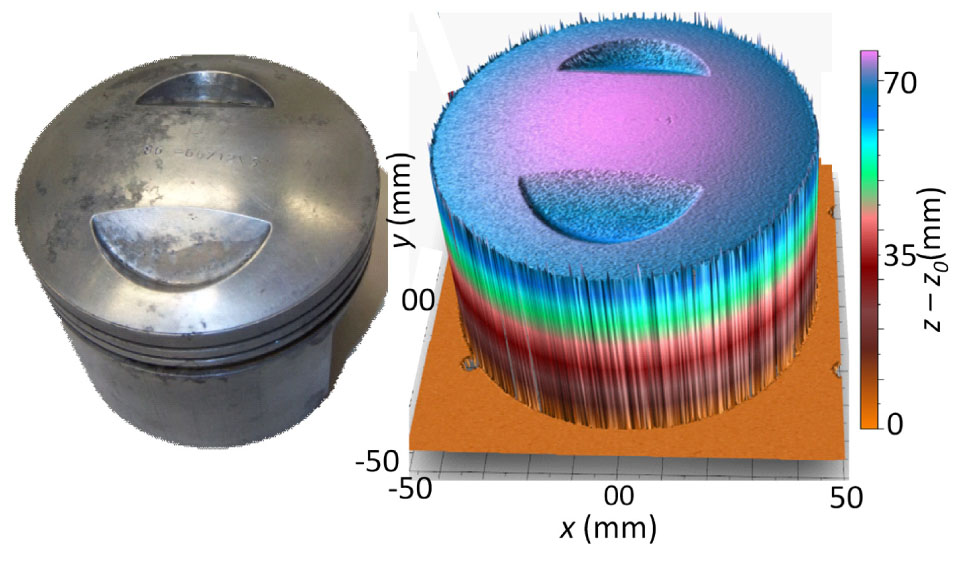
Piston head from Ducati 1975 motorcycle (left), and 1 megapixel 3-D image generated by the NIST system from a distance of 10.587 m (right). [Image: E. Baumann et al., Opt. Express, doi: 10.1364/OE.22.024914]
A team at the U.S. National Institute of Standards and Technology (NIST) has reportedly used frequency-comb calibration to create a system capable of speedily imaging objects more than ten meters away in 3-D, at sub-micron accuracy (Opt. Express, doi: 10.1364/OE.22.024914). The researchers believe that the technique—which relies on low-power lasers at a retina-safe wavelength—could prove useful in applications ranging from precision machining to forensics.
The new NIST technique is a variation of laser detection and ranging (ladar), in which the 3-D image emerges through measurements of the round-trip time-of-flight of laser light shone the object in question. The accuracy of the ladar technique has particularly benefited in recent years through the use of frequency-modulated continuous-wave (FMCW) lasers, which sport high optical bandwidths that have allowed steady increases in sensitivity and accuracy. In these systems, the light scattered from the target is compared with the source light; the optical frequency difference is proportional to the range between source and target, and that relationship allows for the distance to individual points to be measured and converted into a 3-D image.
In the newly developed approach, frequency-comb calibration is the “secret sauce” for practical, high-resolution ladar imaging at a rapid clip. The system continually references the range measurement signal to the perfect, equdistant tooth spacing of a free-running frequency comb, which acts as the system’s frequency “ruler.” Using the calibration from the frequency comb, rather than a physical system such as an interferometer, makes the system less vulnerable to environmental changes that could reduce accuracy. It also allows for sub-micron-accuracy measurements at a rate of two per millisecond (around 8.3 minutes for a million-pixel image), reportedly far faster than in interferometer-based systems, which require continuous calibration.
The lasers in the NIST system operate at a retina-safe infrared wavelength, and at a power of only 9 milliwatts—which could make them truly eye safe in field applications—and the system can reportedly provide images at stand-off distances of 10.5 meters. Right now the system is implemented in fiber optics, and in a desktop-scale device, but the scientists note that, in principle, it should be adaptable to chip-scale devices.
One interesting potential application, according to the team, lies in crime-scene forensics, where a digital “cast” of a footprint could be taken in the form of a 3-D image, and matched to an image of a suspect shoe tread—all without touching or disturbing the evidence itself. A NIST video shows one such detailed image.
