

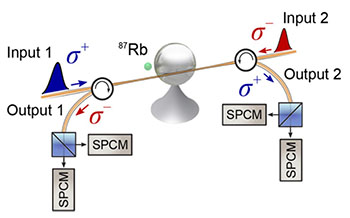
Experimental setup for the photonic switch. Credit: Shomroni et al., Science, DOI: 10.1126/science.1254699.
Robust all-optical routing of single photons would mark an important milestone toward true quantum networks, in which quantum information passes through photonic circuits, carried by individual photons. A team from the Weizmann Institute of Science in Rehovot, Israel, has reported a new step toward practical optical routing: a switch—consisting of a single atom and activated by a single control photon—that’s capable of routing another single photon from any of two inputs to any of two outputs (Science, DOI: 10.1126/science.1254699).
The device consists of a single 87Rb atom, coupled to a chip-based silica microsphere whispering gallery mode resonator. Photons pass to and from the microsphere through tapered nanofibers, with single-photon counting modules (SPCMs) to measure the signal in one of two output states. The ability of the atom to act as a single-photon switch involves the interaction between the internal state of the atom and the sigma polarization of the incoming photon: reflection of a single control photon toggles the atom from a high reflection to a high transmission state.
If the initial state of the atom is mF = –1, for example, and the control photon is σ+ polarized, destructive interference forces the atom to emit a σ– photon in the opposite direction, essentially reflecting the light backward—and toggles the atom into the mF = +1 state. That state, in turn, can allow a second σ+ photon to be transmitted rather than reflected, and can be toggled back to the mF = –1 state by reflection of a σ– control photon. “The system therefore behaves as a symmetric toggle-switch,” the researchers write, “with two inputs, two outputs and two internal states.”
The team believes that the setup—which operates via identical single-photon pulses, traveling in fiber and capable, in principle, of activating multiple devices—can play well with scalable photonic architectures. The scheme, the researchers suggest, could constitute a “versatile, robust and simple building block” for devices ranging from quantum memory to passive photonic quantum gates.
