

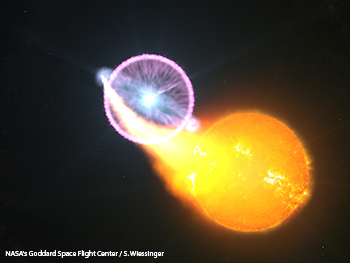
An artist’s rendering shows how common novae occur in binary systems containing stars like our sun. When multiple shock waves expand from the rapidly expanding shell over tens of thousands of years, faster shocks may overtake slower shocks, accelerating particles that could produce gamma rays (magenta).
The international Fermi-LAT (Large Area Telescope) collaboration of more than 160 astronomers has announced the detection of unexpected gamma rays from three classical novae, white dwarf stars undergoing runaway thermonuclear explosions that cause sudden brightening of the star. The observations from NASA’s Fermi Gamma-ray Space Telescope confirm that these common novae are likely a typical source of gamma rays (Science, doi: 10.1126/science.1253947). Until this discovery, astronomers suspected that powerful cosmic sources like black holes and quasars could produce gamma rays, the most energetic and mysterious photons in existence, but novae were not considered capable of producing energies high enough to generate them.
Novae are relatively common outbursts that occur when a white dwarf in a binary system of two companion stars accretes enough hydrogen from its larger companion star to undergo nuclear fusion. In 2010, astronomers discovered what they thought was unusual variable gamma-ray emission coming from the nova V407 Cygni, a rare symbiotic binary system of a white dwarf and a red giant. But the confirmation of similar high-energy emission from three classical novae confirms that they are likely another galactic source of these gamma rays.
In a NASA press release, lead author and astrophysicist Teddy Cheung with the U.S. Naval Research Laboratory said, “There's a saying that one is a fluke, two is a coincidence, and three is a class, and we're now at four novae and counting with Fermi."
The team proposed that the gamma-ray emission may be generated from the interaction of multiple shock waves that accelerate particles to near the speed of light.
