

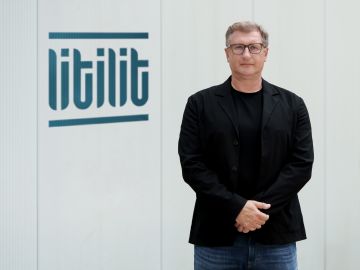
Nikolajus Gavrilinas, cofounder and CEO of LITILIT. [Image: LITILIT]
Lithuanian laser manufacturer LITILIT is building a new automated femtosecond-laser factory in Vilnius and plans to ramp up annual production capacity to as many as 3,000 systems over the next few years. If the company reaches its targeted production levels, the Vilnius facility could provide a useful test of how far automation and simplified architectures can push femtosecond lasers toward more standardized, higher-volume industrial production.
The company says it is investing approximately €6 million in the facility, which will occupy around 4,000 m2 and will incorporate robotic laser assembly as well as CNC metalworking and testing lines. Manufacturing is expected to commence in 2027.
The company expects to initially manufacture around 1,000 lasers annually before scaling toward its planned 3,000-system capacity. The expansion is aimed at addressing one of the persistent challenges surrounding femtosecond lasers: translating the precision and performance of ultrafast systems into manufacturing processes that can support significantly higher production volumes.
The country has built a significant laser sector over the past six decades, with an estimated 90–95% of Lithuanian laser production exported to more than 80 countries.
LITILIT says its approach relies on proprietary laser architectures, reduced component complexity and a high level of production automation. Femtosecond lasers are used for high-precision processing in industries including semiconductor manufacturing, electronics and medical-device production. In an announcement LITILIT CEO and co-founder Nikolajus Gavrilinas also points to growing opportunities in semiconductor advanced packaging and in the production of optical components for AI data-center infrastructure.
The factory comes amid broader efforts by Lithuania to strengthen its position in high-technology supply chains. The country has built a significant laser sector over the past six decades, with an estimated 90–95% of Lithuanian laser production exported to more than 80 countries. The sector has been growing at more than 16% annually, according to Lithuania’s Innovation Agency.
That international focus has recently extended to closer economic ties with the United States. On 17 September, Lithuania and the US signed a bilateral agreement intended to strengthen cooperation on critical minerals, advanced technologies and supply-chain resilience. Lithuanian officials have subsequently identified semiconductors and other advanced technologies as areas where bilateral cooperation could expand.
Although the agreement does not specifically cover laser exports, LITILIT sees the US as an important market and has said it ultimately hopes to replicate its manufacturing model with international partners.
