

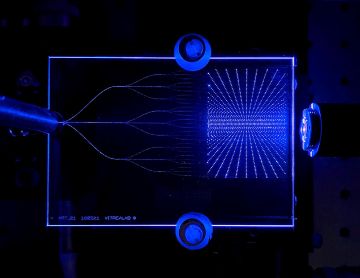
Vitrealab uses proprietary laser-writing technology to etch tiny wave-guides into glass. [Image: Vitrealab]
Austria-based photonics company Vitrealab has closed an $11 million Series A financing round to accelerate the development and industrialization of its Quantum Light Chip (QLC) technology. QLC uses laser-based photonic integrated circuits (PICs) to create intense, collimated light for energy-efficient displays in augmented reality (AR) glasses and virtual reality (VR) headsets.
The round was led by LIFTT Italian Venture Capital and LIFTT EuroInvest, and included PhotonVentures, Constructor Capital, xista Science Ventures and Moveon Technologies, among others. Vitrealab confirmed that the raise was “significantly oversubscribed.” CTO Jonas Zeuner noted that the investment will enable the firm “to move from advanced prototypes to industrial-grade solutions, while continuing to push the boundaries of what is possible with photonic integrated circuits in display applications.”
Vitrealab’s technology uses PICs to control and shape coherent laser light for laser–liquid crystal on silicon light engines. This approach streamlines system architecture, minimizes optical losses and reduces overall size, while preserving polarization and beam integrity. The result is greater brightness, wider fields of view and lower power consumption—all critical for lightweight AR smart glasses.
Vitrealab, which is a spin-off of the University of Vienna, also plans to strengthen collaborations with customers and partners, and build the technical foundation (including next-generation light engine architectures) required for broad AR adoption.
Augmented reality has reached a point where the market is ready but display hardware continues to lag.
“Augmented reality has reached a point where the market is ready,” said Marco Cravetto, business analyst at investor LIFTT, but display hardware continues to lag. Vitrealab aims to solve challenges typically encountered in AR displays such as brightness, size and power consumption to facilitate mass adoption. Their light engines offer extreme brightness (making them visible even in sunlight) and high efficiency crucial for AR glasses.
Central to Vitrealab’s strategy is its vertically integrated model, whereby the company designs and manufactures its own photonic devices using in-house tools and proprietary direct-laser-writing processes, which enables quick iteration while maintaining a steady production channel.
For those working in the design and engineering of AR displays, the investment signals a broader shift: integrated photonics is moving beyond its traditional role in communications and sensing and into consumer-oriented optical systems, where factors such as efficiency, compactness and scalable manufacturing will determine whether promising prototypes can evolve into everyday products.
