

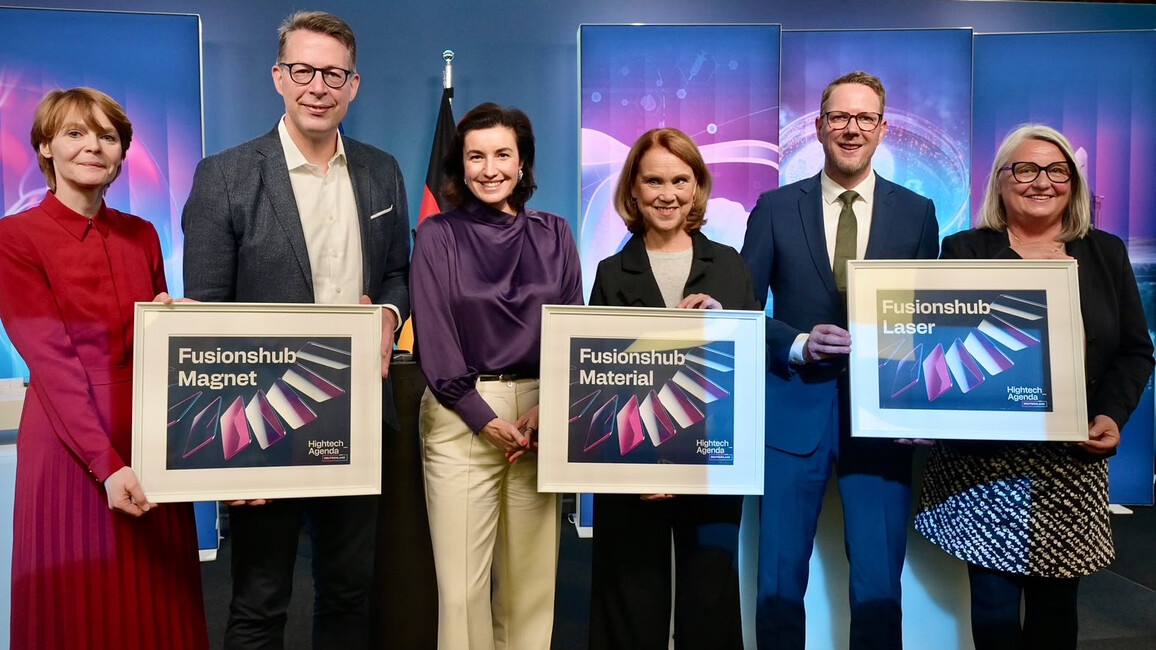
Representatives of the German federal and state governments present the three fusion hubs. [Image: BMFTR]
Germany is establishing three national fusion-technology hubs designed to bring together research institutions and industry in an effort to accelerate development of commercial fusion power.
The initiative was announced by the Federal Ministry for Research, Technology and Space (BMFTR, by its German acronym) and it forms part of Germany’s broader push to advance fusion commercialization. It builds on the government’s Hightech Agenda Deutschland, its Fusion 2040 research-funding program and a 2025 federal action plan aimed at establishing a commercial fusion power plant in Germany.
The ministry is initially providing €125 million to support three hubs, known as VEGA, STRIDE and MAT-TRIX, which will focus on laser fusion, magnetic fusion and cross-cutting challenges including fuel cycles and advanced materials, respectively.
The program comes amid growing international competition to commercialize fusion energy, with governments, national laboratories and privately funded companies increasing investment in magnetic-confinement and laser-driven approaches. Germany's hub structure is intended to strengthen links between scientific research and industrial deployment while establishing domestic supply chains and technical capabilities.
Photonics at the center
Of particular relevance to the optics and photonics sector is VEGA, the hub dedicated to laser fusion. Coordinated by Marvel Fusion and Focused Energy, it aims to consolidate existing expertise in Germany in photonics, optics, laser technology and fusion-target development and manufacturing, while creating closer links between research organizations, technology suppliers and companies pursuing commercial fusion systems.
Unlike magnetic-fusion concepts, inertial fusion relies on advances in high-energy laser systems, precision optics, optical coatings, diagnostics and metrology, making photonics a key enabling technology on the path toward commercial laser-fusion power generation.
VEGA will include a fusion R&D campus in Hamburg, centered around the European XFEL facility, with work spanning laser physics, diagnostics and materials research. A second fusion industrialization campus in Biblis, Hesse, is intended to support the transition toward large-scale manufacturing and deployment.
Research partners include European XFEL, DESY, the University of Hamburg, Kiel University and the University of Rostock, alongside a network of industrial and academic collaborators.
In a statement accompanying the launch, Marvel Fusion CEO Moritz von der Linden said:
"Fusion energy will be the energy source of the 21st century. With today's funding decision by the BMFTR, the Laser Fusion Hub becomes the place where we accelerate research using existing infrastructure and translate it into market-ready technologies: industry-led, open to the entire ecosystem, and grounded in world-class science.”
VEGA is initially pursuing five research projects addressing technological barriers to commercial laser fusion including SAVGUR, an open-source 3D simulation framework for fusion-target design; SCALABLE-FI, investigating high-efficiency fast-ignition concepts based on nanostructured targets; OCLIP, focused on lifetime modelling and testing protocols for optical coatings exposed to high-energy laser systems; SCOPE-IFE, a shared diagnostics platform incorporating AI-assisted laser stabilization; and METROTARG, which will develop precision metrology techniques for cryogenic fusion targets.
Complementary fusion technologies
Germany’s other two hubs will address other challenges in fusion-energy development.
STRIDE, coordinated by Proxima Fusion, Gauss Fusion and the Max Planck Institute for Plasma Physics, will focus on magnetic fusion, particularly stellarator technology, with the goal of translating scientific advances into industrial implementation.
MAT-TRIX, coordinated by the Karlsruhe Institute of Technology (KIT), will address fuel-cycle and materials-development issues, including tritium production and handling, breeding blankets and materials capable of withstanding the extreme thermal and radiation operating conditions inside fusion reactors.
The hub partners are also developing common R&D programs, intellectual-property frameworks and workforce plans. Funding will be rolled out in successive phases through 2029 and may be supplemented by private investment, contributions from Germany's federal states and international collaborations.
