

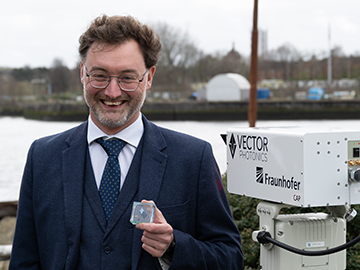
Vector Photonics CEO and founder Richard Taylor. [Image: Courtesy of Vector Photonics]
Scottish startup Vector Photonics announced in early April what it calls the first successful public demonstration of photonic crystal surface emitting laser (PCSEL) technology for optical communication outside of a lab. On 31 March, Vector’s PCSELs were used to transmit data across the River Clyde from the Glasgow Science Centre to the Clydeside Distillery.
“This is a major step forward for Vector Photonics, proving that our technology is a commercial reality in real-world applications,” said Vector founder and CEO Richard Taylor. “We believe that the demo is the most advanced application of a PCSEL to date, advancing it from a Technology Readiness level of 4/5 (Technology validated in lab / relevant environment) to 6/7 (Prototype demonstrated in operational environment).”
PCSELs for communications
PCSELs represent a distinct class of semiconductor laser, integrating a two-dimensional photonic crystal into the emission region to achieve coherent, single-mode output over a relatively large aperture. This architecture enables simultaneous high output power and low beam divergence—characteristics that are difficult to achieve together in conventional devices. In effect, PCSELs bridge the gap between edge-emitting lasers, which offer high power but poorer beam quality, and vertical-cavity surface-emitting lasers (VCSELs), which provide excellent beam characteristics but are typically power-limited.
Vector says that these properties make PCSELs particularly well suited to free-space optical communications, where link performance depends on beam quality, pointing tolerance and optical efficiency. Low divergence is important for minimizing signal loss over long distances, while high brightness improves receiver sensitivity and link margin, according to the company. And they can be efficiently coupled into free-space optics without complex beam-shaping elements.
Out of the lab
Previously, experiments using PCSELs for communications had only been done in the lab under ideal conditions and simulations, according to Vector. To validate these advantages under realistic conditions, the company carried out a field trial across a 500-m link over the River Clyde in Glasgow, UK. The free-space optical communication system was designed and constructed using Vector Photonics’ PCSELs by Fraunhofer Centre for Applied Photonics (CAP), part of Fraunhofer UK.
The system achieved data rates of 50 Mb/s while maintaining stable operation and error rates below standard forward error correction thresholds—twice the system spec required for the experiment, but well below the figure achievable for PCSELs, which have a naturally high data rate. This was achieved despite variable environmental conditions, including changes in temperature, humidity, precipitation and wind turbulence.
A variety of applications
Vector says that this latest breakthrough could enable faster, secure internet connections between buildings, campuses, and even satellites, without relying on cables or radio signals. The company has also set its sights beyond communications applications, noting that its wavelength flexibility spanning the UV to far infrared also allows PCSEL technology to be applied to AI data centers, lidar systems and additive manufacturing.
Gerald Bonner, principal researcher at Fraunhofer CAP, said: “This project has been a great opportunity to deploy Fraunhofer CAP’s capabilities in the development of optical systems to assist Vector Photonics in demonstrating the growing maturity of PCSELs and the potential of this important new diode laser technology in optical communications.”
