

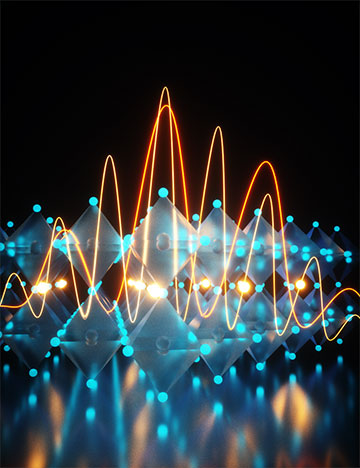
New types of semiconductor devices that respond to light could be possible using perovskites. Recent research shows that halide perovskite crystals reversibly change shape when exposed to light. [Image: Marina Leite, University of California, Davis]
Halide perovskite crystals can change shape predictably when exposed to light. The bending occurs rapidly, reverses itself when the light is shut off and is free of hysteresis.
Researchers in the United States and Switzerland quantified the effect in three types of lead bromide crystals under varying illumination (Adv. Mater., doi:10.1002/adma.202521800). The work could lead to new, less expensive types of photonic switches and other devices.
“They are ‘smart materials’ that can be tuned to respond to a stimulus in a way we can control,” said researcher Marina Leite, University of California, Davis, USA. “Their chemistry is very different in a way that can be beneficial for creating devices we couldn’t build before.”
A close look at perovskites
Perovskite is a name for compounds with the general formula ABX3, where A and B are cations (often of multiple atoms) and X is an anion, usually bromide or iodide. Scientists have been investigating perovskites for use in LEDs and other photovoltaic devices. Although some evidence showed that light could distort the lattices of perovskite crystals, further studies needed to be done before trying to use the substances in actual devices.
Researchers at the University of California, Davis chose three types of perovskite crystals grown by a team in Switzerland: two hybrid organic-inorganic compounds, methylammonium lead bromide and formamidinium lead bromide, and an inorganic compound, cesium lead bromide. The team irradiated the crystals with 532-nm laser light and used X-ray diffraction to probe the distortions that took place within the crystal lattice during illumination.
Changing shape with light
The scientists found that the two organic-inorganic perovskites, with a cubic crystal structure, demonstrated higher changes in interplanar lattice spacing under light stimulation than the cesium-based orthorhombic crystal. The methylammonium compound changed by 0.3%, while the cesium compound changed only by 0.062% in spacing. The A-site cation in the ABX3 formula appeared to be the most responsible for the deformation, which also varied with the power of the illumination.
“There is a dramatic change in the lattice when you shine light on it, a unique phenomenon that you don’t see with silicon or gallium arsenide,” Leite said. “It’s not a binary on/off effect; it can be a scaled response, like a dimmer, depending on the light you shine on it.”
Finally, the team predicts that iodide-based crystal compounds will react similarly to illumination, depending on the strength of bonding between the cation and the halides in the lattice.
