

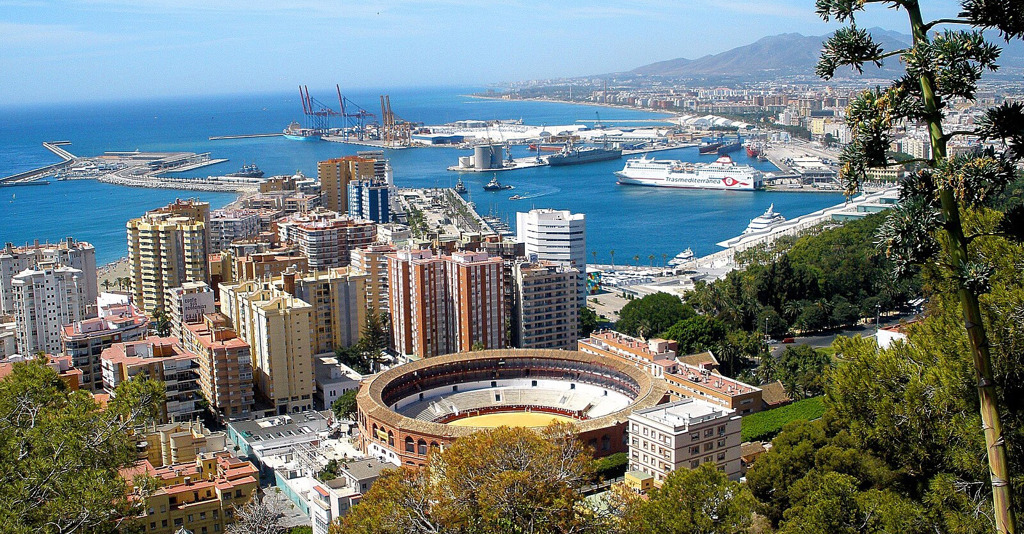
 An aerial view of Málaga, Spain. [Image: Wikimedia Commons; CC-BY 1.0]
Optica's Global Photonics Economic Forum (GPEF) 2025 took place in October under the warm skies of Málaga, in southern Spain. The warm air, bright light and the sound of waves on the Costa del Sol offered a welcome counterpoint to the uncertain economic climate that dominated the forum’s agenda.
The event’s second edition drew roughly 300 senior executives, investors and policy makers for two days of high-level dialogue on the global photonics industry.
“The idea was to bring the leaders and decision makers of the photonics industry together,” said Reinhard Voelkel, co-chair of the GPEF and former CEO of SUSS MicroOptics. “We wanted a place small enough that people can talk to everyone, but with enough weight to attract those who truly shape the industry.”
That formula worked. Building on the success of last year’s debut, the 2025 forum again gathered senior executives from imec, Edmund Optics, nLIGHT, IPG Photonics, Coherent, Thorlabs, MKS, AMD, Google, GlobalFoundries and other opinion leaders. Plenary keynotes and panel discussions alternated with unhurried networking breaks—an atmosphere deliberately designed for candid, off-the-record conversations among industry, investors and policymakers.
Andalucia's rise as a tech hub
Spain’s economy is growing robustly, and the Andalucian region has made high tech a policy priority. In their welcoming remarks the local Minister of Economy, Finance, and European Funds, Carolina España Reina and the Mayor of Malaga, Francisco de la Torre Prados, highlighted the region’s growing innovation ecosystem.
Málaga’s TechPark has become a southern European magnet for advanced manufacturing and R&D. Recently, the Spanish government approved €500 million in funding for a new Center for Photonic Integrated Circuits, to be managed by imec, Belgium’s research and innovation hub for nanoelectronics and digital technologies. “Building a fab in Europe—and in Spain—is very challenging,” noted Optica CTO Jose Pozo, “but it’s happening, and it shows how fast this region is moving into advanced manufacturing.”
Opportunities and persistent challenges
Co-chair Voelkel sees both promise and peril in the current landscape. The promise lies in photonics’ ability to alleviate the looming energy bottleneck created by artificial intelligence. “Semiconductor companies like Nvidia and TSMC are calling for help,” he said. “Photonic Integrated Circuits and co-packaged optics could dramatically increase speed and cut energy consumption.”
Yet tariffs, supply-chain fragility, and the lack of common standards remain stubborn barriers. “The semiconductor industry’s success is built on agreed standards,” Voelkel reminded the GPEF 2025 audience. “In photonics, we’re still far from that point.”
Many sessions expanded on those themes. Periplous LLC President Michael Hochberg warned that geopolitical realignments could return global trade to “something resembling the 1930s.” Abhijit Mahindroo, senior partner co-leading the Semiconductors group at McKinsey & Company, took that thought further, connecting supply chains, geopolitics, and technology trajectories in a tour-de-force presentation that became one of the forum’s talking points.
$7 trillion, AI driven wave
"Progress does not happen in isolation. The breakthroughs driving our economy come from collaboration across the value chain. Trust is the true currency of progress.”
Elizabeth Nolan, Optica CEO
Mahindroo began by referencing economist Thomas Friedman’s Golden Arches Theory—the notion that shared supply chains prevent conflict—and questioned whether that theory still holds true today. Despite ongoing global tensions, Mahindroo sees entirely new times coming: The “age of intelligence is replacing the age of connectivity,” he said—A change that, although he didn’t state it explicitly, may have profound implications for photonics.
Using the evolution of the iPhone as a case study, Mahindroo illustrated what 18 years of annual innovation can achieve: a device ten million times more powerful than its 2007 ancestor, backed by an intricate, globe-spanning supply chain. If AI hardware and infrastructure advance at similar pace, he predicted, the world is heading toward a $7 trillion investment wave over the next five to seven years—roughly seven times larger than the Manhattan Project, the Marshall Plan, or the entire internet build-out.
What’s most striking about this wave, Mahindroo emphasized, is that the capital will come not from governments but from the balance sheets of the world’s most profitable private companies. To sustain that rate of progress, he noted, AI itself must be applied to every phase of development, from materials discovery and chip design to manufacturing and logistics—a conclusion that resonated with another major voice at the forum, former CEO of Coherent Corp. Chuck Mattera.
Call for an AI–materials loop
During the “Photonics Profit from Semicon” panel, Mattera warned that the convergence of photonics and electronics is accelerating far faster than traditional R&D models can handle. “To advance the next 50 years—and to mitigate the unnecessary waste of electricity and water projected by 2030—we must adopt AI systems capable of closing the loop between materials, design and process,” he argued.
Mattera called for a new generation of AI-driven design environments that could cut development time and cost “by half.” His vision dovetailed neatly with Mahindroo’s analysis: only by embedding AI into the very act of innovation can industry sustain exponential progress without exhausting physical and human resources.
Leadership stories and corporate culture
Beyond the macroeconomics, the forum also explored leadership in times of volatility. Marisa Edmund of Edmund Optics and Jennifer Cable of Thorlabs each offered their own perspectives on how family-owned firms can stay agile in turbulent markets. While both leathers spoke from the vantage point of multigenerational businesses, change in stock-listed companies might be just as interesting. Mark Gitin detailed how IPG Photonics evolved from a founder-driven enterprise into a company with a collaborative, team-based culture. And nLight Scott Keeney made the audience think, when he spoke about his company’s strategic decoupling from China–and what his board thought about it.
Trust as the industry’s true currency
Trust, in fact, became the event’s leitmotif. “If there’s one word that defines our operating environment right now, it’s uncertain,” said 2025 Optica President Jim Kafka. “That’s why trust matters—not the easy kind built in times of shared success, but the deliberate kind forged through genuine collaboration.”
Optica CEO Elizabeth Nolan echoed the sentiment: “Progress does not happen in isolation. The breakthroughs driving our economy” she said, come “from collaboration across the value chain.” “Trust is the true currency of progress” she added.
Celebrating impact: The Optica i4 Prizes
That spirit of collaboration was embodied in the Optica i4 Prizes, presented during the first day’s plenary session. These prestigious awards honor individuals and organizations who exemplify Optica's core values—innovation, integrity, inclusivity and impact—as well as preseverance, business and technology foresight and visionary leadership.
The Corporate Achievement Prize went to Corning Incorporated, honored for breakthroughs that “define optical innovation,” from deep-sea periscopes and the Hubble Telescope to Gorilla Glass and the ultra-low-loss fibers now enabling scalable quantum computing with Xanadu. “There is no AI without glass,” the laudator Ulrike Fuchs noted, acknowledging Corning’s foundational role in fiber optics, quantum technologies and EUV lithography.
The Individual Prize recognized John T. C. Lee, President and CEO of MKS Instruments, for transforming MKS from an instrumentation supplier into a diversified global technology company. Kafka lauded Lee’s establishment of the President’s Technology Innovation Grant program, which funds cross-divisional projects that push the boundaries of possibility. “while many companies can solve simple problems,” Kafka explained, “MKS is distinguished by its ability to help solve our customers' most complex challenges.”
Make photonics more visible
As the forum turned to forward-looking sessions, Stefan Traeger, CEO of JENOPTIK, urged the audience to make photonics more visible to the broader public as well as to policy makers. Photonics, he emphasized, is a key enabling technology not only for communications and healthcare, but also for defense. At its core, he argued, photonics embodies innovation, global collaboration and highly interconnected international supply chains. For the photonics industry to thrive, it needs stability and as much global cooperation as technological excellence.
He noted that most participants at the GFEP 2025 hailed from Europe and North America. "That is something we can work on," he said, "to bring the Global Photonics Economic Forum really to the worlds and include people from Asia and other regions of the globe."
Despite the weighty topics under discussion—energy consumption, defense, supply security—the atmosphere remained constructive during the two days. Participants repeatedly emphasized cooperation across borders and sectors as the surest path through turbulent times.
A warm outlook from the Mediterranean
Serious debate gave way each evening to genuine camaraderie. Receptions at El Balneario Nuestra Señora del Carmen and in Málaga’s historic center blended seaside charm with strategic conversation. Under palm trees and over tapas, executives who normally compete exchanged insights freely, demonstrating that trust can be built, even in uncertain times.
As the sun set over the Andalucian coast, attendees left with renewed optimism. If the first two editions of Optica’s Global Photonics Economic Forum are any guide, the event is on its way to becoming a cornerstone of the global photonics calendar—an annual destination for strategic dialogue, insight and collaboration.
A recording of the event is available on Optica’s YouTube channel
Andreas Thoss is a freelance writer based in Berlin, Germany.
