

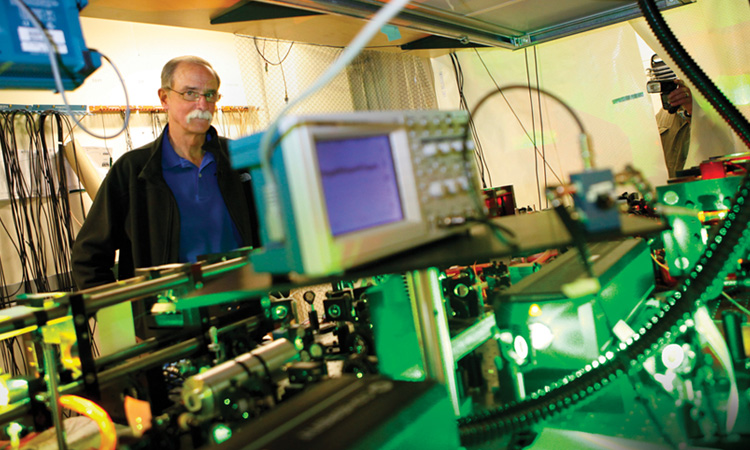
 David Wineland in his lab at NIST in 2012. [D. Romanoff / Stringer / Getty Images]
David Wineland, University of Oregon, USA, shared the Nobel Prize in Physics in 2012 with Serge Haroche, Collège de France, Paris, for his work devising methods to study the quantum mechanical behavior of individual atomic ions. At the 2025 Frontiers in Optics (FiO) meeting in Denver, CO, USA, held from 26 to 30 October, he will give a plenary talk exploring how quantum state superpositions and entanglement are employed with trapped atomic ions in spectroscopy, clocks and quantum computation. OPN spoke with Wineland before the meeting to hear about his career in quantum science.
Q. How did you get started in your career as an experimentalist?
I was always pretty good at math, and when I started college, I was actually a math major. But then I started taking some physics classes, and those were really interesting to me. So by the time I was a junior and senior, I had become a physics major, and it stuck. It was a fairly easy transition to make because of course there’s a lot of math in physics.
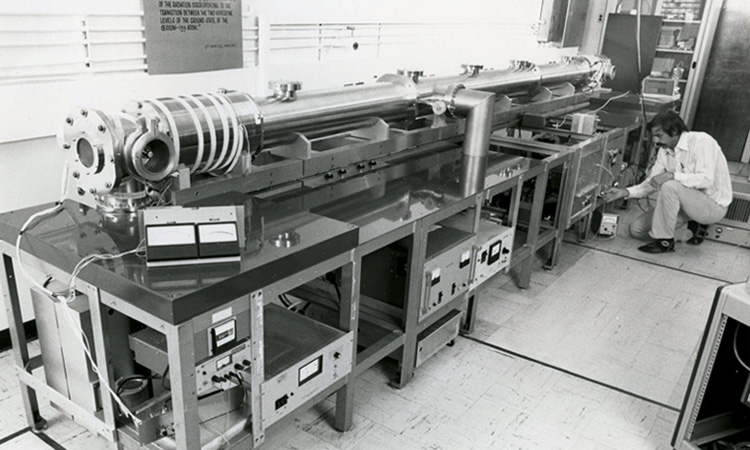 David Wineland with the NBS-6 Atomic Clock at NIST in the 1970s. [D. Wineland / NIST]
The other thing is that growing up, I always liked making things and working with my hands. When I was young, I liked model airplanes, and then later, I was working on motorcycles and cars and things like that. So I had some skills that would be useful in the lab, working on experiments.
Q. What do you think are some of the most exciting developments in quantum science since you won the Noble Prize in 2012?
I think that change in the field of quantum science has been gradual, but certainly people are getting closer and closer to making a practical quantum computer. It’s still a ways off because the technology is hard. The basic ideas are sound, but in the experiments, we have to get rid of the technical flaws and the noise and things like that, and that’s a hard problem. It’s easy to say that we have to get rid of the noise that disturbs the dynamics we’re trying to produce, but actually doing it is difficult. But I’m optimistic it’s going to happen.
“Change in the field has been gradual, but certainly people are getting closer and closer to making a practical quantum computer.” —David Wineland
People have also come up with ways to use the same ideas to make secure communication systems—a lot of the same physics applies for that communications application, and progress is steady.
Q. A goal of the UN International Year of Quantum Science and Technology is to teach the public about quantum science. How do you think we can approach
that outreach?
You probably can’t get a full understanding of quantum science without going into the math, but we can convey the interest to people to get them started. For example, one experiment we do in our lab is that we store atomic ions in an electromagnetic trap. But to make that a bit simpler, you can picture the atom as a marble that rolls back and forth in a bowl, which is the trap.
One of the fun things we can do with our trapped atomic ions is we can make a superposition state. In our bowl analogy, this would mean that at some instances of time, the marble is on the left side of the bowl and the right side of the bowl at the same time. This makes no sense in our ordinary, everyday experience, but this is what we can do in quantum science. There’s an easy mathematical explanation of how we can make this happen, but it’s certainly startling if you just say that alone, which will catch people’s attention.
Q. Was there a problem or technical challenge in your career that you think of as particularly interesting or memorable?
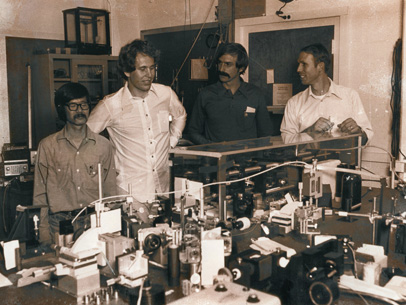 Experimental physicists Wayne Itano, Jim Bergquist, David Wineland and Bob Drullinger in 1979. [D. Wineland / NIST]
When I started graduate school, I worked for Professor Norman Ramsey at Harvard. He was very interested in making better frequency standards, and so he and his colleague Dan Kleppner invented the hydrogen maser, which uses the oscillatory properties of the hydrogen atom as a precision frequency reference. They’re still in use in a lot of applications, and Ramsey went on to win the Nobel Prize in Physics for his invention of the separated-fields method in spectroscopy and development of the hydrogen maser.
“As quantum computing gets better, we should be able to solve some physics problems theoretically that are intractable now. ” —David Wineland
Since then, most of my career has been working on atomic clocks. With atomic clocks, one of the shifts that we have to calibrate out to get accurate frequency measurements is time dilation. This concept comes from Einstein: the fact that atoms—or in our case, charged atoms or ions—are moving. So for them, time moves at a different rate than it does for us in the lab, and this can introduce errors in timekeeping. We have to at least know the speed of the atoms very well to calibrate this difference out.
A partial solution that we came up with to mitigate this problem was laser cooling. Basically, we would just cool the ions down using the radiation pressure from lasers, so that they are less affected by this time dilation. I think that development was probably one of the biggest parts of my career; if not the first, we were certainly one of the first groups to demonstrate laser cooling. And now it pervades a lot of atomic physics, quantum computing, and lasers and devices like that. Laser cooling is very important in atomic versions of quantum computing, since the movement of the ions affects the fidelity and accuracy of the operations that we can perform.
Q. What are your hopes for the future of quantum science?
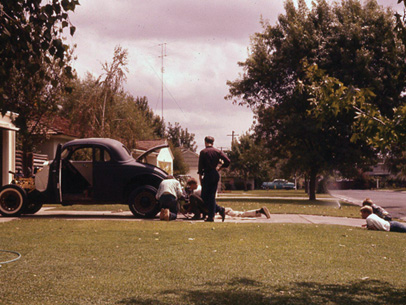 Before he was a quantum mechanic, 16-year-old David Wineland and his friends enjoyed working as amateur mechanics on a 1936 Ford. [D. Wineland / NIST]
I think as quantum computing gets better, we should be able to solve some physics problems theoretically that are intractable now. As systems get more complicated, it’s harder to solve the dynamics of how they behave using classical physics. But with a quantum computer, we can maybe simulate those dynamics without actually having to first build the device or whatever in the lab. The ability to verify Einstein’s predictions with high accuracy and things like that are very exciting for physicists, and this is also something we can talk about with the public.
Another example of where a quantum computer could come into play is if we’re trying to invent a new chemical that might be used in drug therapy. It would be great if we could simulate the action of whatever this chemical was without having to synthesize it in the lab. Instead of having to try to make these chemicals and then finding out they don’t work, we could simulate their behavior in advance using a quantum computer. We’re only touching on those kinds of things now, but that would be an important application if we could make a very good quantum computer.
There are some pie-in-the-sky ideas out there, but many of them are generally valid. It’s fun to talk about the “gee-whiz” aspects of the quantum world. For me, the fun really doesn’t wear out.
