

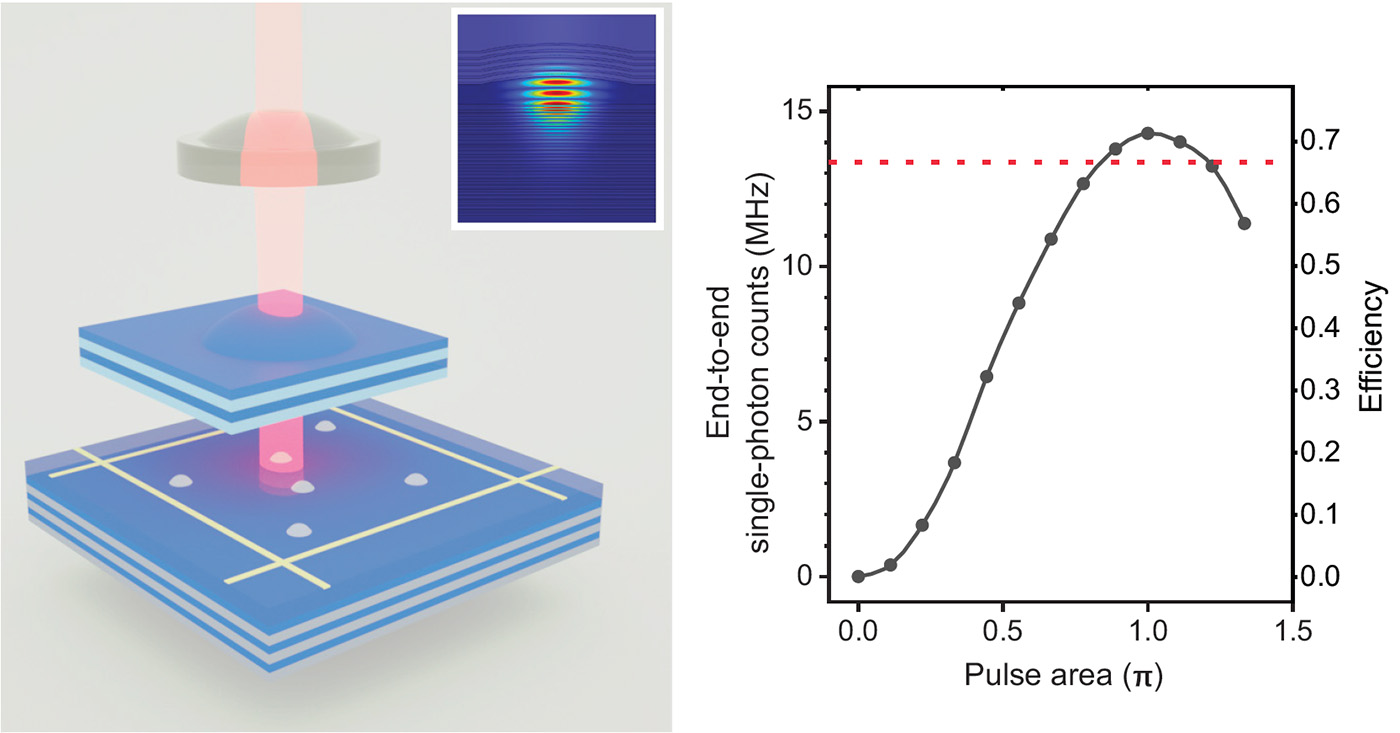
 [Enlarge image]Left: Schematic of the quantum dots integrated in a fully tunable open-cavity setup. Right: Resonance fluorescence photon counts as a function of excitation pulse area. At the π pulse, the system efficiency reaches a maximum of 0.712. The red dotted line indicates the 2/3 loss-tolerant threshold value in optical quantum computing
Scalable photonic quantum computing faces a fundamental bottleneck: photon loss. The inevitable loss of photons in sources, circuits and detectors corrupts computations. Within linear optical quantum computing (LOQC), these losses can be remedied by error correction, but only if the system achieves a combined source-and-detection efficiency above the crucial 2/3 threshold. For years, even the most advanced single-photon sources have fallen short of this threshold, creating a major roadblock for the field.
In a recent breakthrough, we have demonstrated a single-photon source that overcomes this long-standing efficiency limit for the first time.1 Our work centers on a single quantum dot (QD) deterministically coupled to a tunable open microcavity. The key innovation lies in in-situ coupling a QD to the cavity and using tailor-shaped laser pulses for excitation. We report an overall system efficiency of 0.712, a figure that comfortably exceeds the required 2/3 threshold for loss-tolerant LOQC.
Crucially, this record efficiency is reached without sacrificing photon quality, exhibiting near-perfect single-photon purity (g(2)(0) = 0.0205) and near-unity indistinguishability (0.9856). The source is efficient and robust enough for the observation of 40 consecutive photon-detection events, a direct demonstration of its power for multi-photon applications.
The source’s performance makes it immediately applicable to near-term quantum demonstrations, including boson sampling, photonic cluster-state generation and secure quantum communication. Furthermore, the underlying QD-open cavity platform can be readily extended into the strong-coupling regime, offering a tangible pathway to the implementation of high-fidelity photon–photon gates.
This work represents a significant advance toward the realization of scalable, single-photon-based quantum technologies, overcoming one of the most persistent efficiency barriers in photonic quantum computing.
Researchers
X. Ding, Y.-P. Guo, M.-C. Xu, R.-Z. Liu, Y.-H. Huo, C.-Y. Lu and J.-W. Pan, University of Science and Technology of China, China
References
1. X. Ding et al. Nat. Photon. 19, 387 (2025).
