

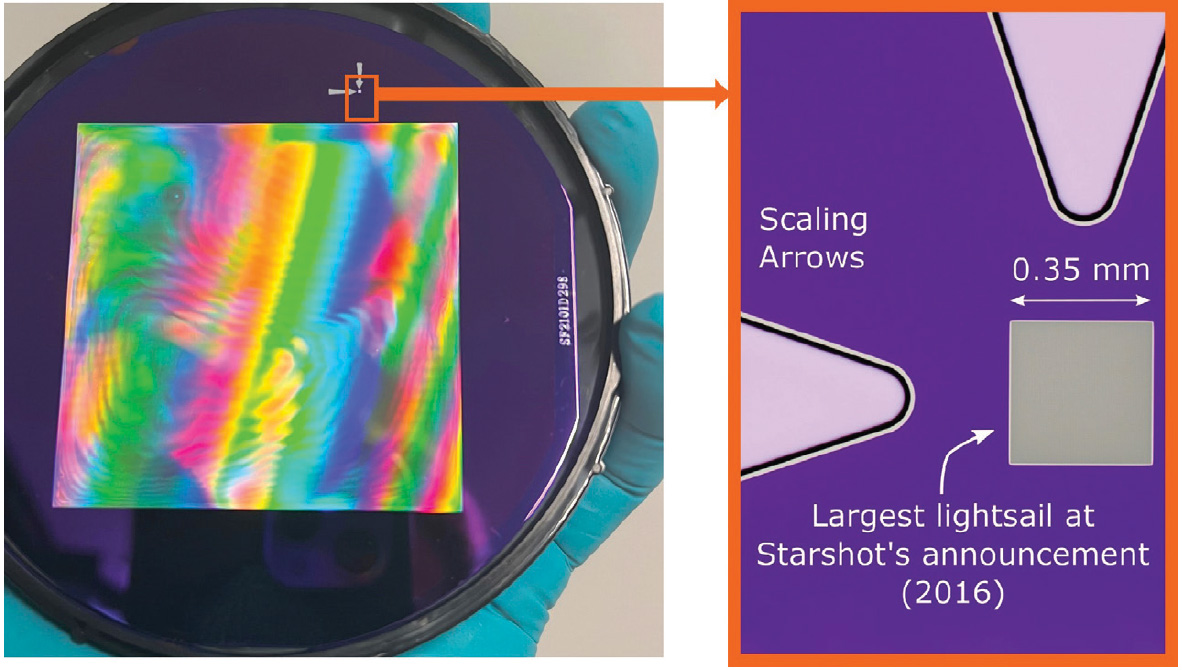
 [Enlarge image]Wafer-scale 200-nm-thick silicon nitride photonic-crystal mirror containing approximately 1.5 billion nanoholes, fabricated using scalable optical lithography. This structure represents the highest-aspect-ratio nanophotonic element produced to date and highlights the advances in lightsail materials since the launch of the Starshot Initiative in 2016. Today’s membranes are more than 30,000 times larger than the suspended photonic crystals available at that time.
The dream of interstellar travel has long been constrained by propulsion limits. One proposed concept utilizes Earth-based lasers to accelerate ultralight “lightsails” attached to chip-scale payloads to 20% of the speed of light, enabling a two-decade journey to Alpha Centauri.1 Achieving this requires reflector membranes with meter-scale area, nanometer-scale thickness and optical performance robust to the Doppler shift of relativistic motion—all fabricated at costs compatible with deploying thousands of sails.
Our team addressed this challenge using neural topology optimization (TO), an inverse-design method combining physics solvers with neural-network reparameterization.2 This neural TO efficiently navigates the photonic-crystal design space, balancing three competing requirements: ultralow mass, broadband reflectivity and manufacturability at scale. This process revealed an uncommon pentagonal photonic-crystal lattice that distributes reflectivity across multiple resonances. This design reduces acceleration time, thereby lowering launch costs by millions of euros per sail.
A critical insight from our work is that the sail’s minimum feature size directly drives cost. Prior lightsail concepts assumed nanometer-scale features accessible only by electron-beam lithography,3 a prohibitively slow and expensive process for square-meter sails. By constraining our design to features ≥500 nm, compatible with high-throughput optical lithography, we demonstrated that wafer-scale sails could be produced 9,000 times more affordably than previous approaches.4 This economic perspective, often overlooked in lightsail design, is as essential as optical performance for realizing the proposed strategy of launching fleets of sails.1
We validated our design experimentally by fabricating a 6 × 6 cm2 suspended SiN photonic-crystal membrane only 200 nm thick and covered with approximately 1.5 billion holes. Therefore, it has the highest aspect ratio of any nanophotonic element reported to date.4 Additionally, the optical reflectivity measurements are consistent with simulations. Remarkably, the membrane exhibited excellent mechanical robustness, surviving transport and handling thanks to intrinsic tensile stress in the SiN film.
This work highlights how extreme-aspect-ratio nanophotonic membranes can unlock new frontiers in optics and mechanics. Scalable fabrication enables applications such as compliant mirrors, ultralight imaging optics and dynamic optomechanical devices.5 Future directions include integrating thermal and structural stability into multi-objective designs, testing membranes under high-power laser illumination and ultimately demonstrating laboratory-scale propulsion.
By coupling neural inverse design with cost-aware nanofabrication, we demonstrate that wafer-scale, ultrathin reflectors can be realized in practice. This marks an important step toward turning the century-old dream of light-driven interstellar flight into a concrete engineering pathway.
Researchers
L. Norder, M.H.J. de Jong, F. Stallone, H. Aydogmus, P.M. Sberna and R.A. Norte, Delft University of Technology, Netherlands
S. Yin and M.A. Bessa, Brown University, USA
References
1. H.A. Atwater et al. Nat. Mater. 17, 861 (2018).
2. S.M. Sanu et al. Struct.Multidiscip. Optim. 68, 1 (2025).
3. J. Moura & R.A. Norte et al. Opt. Express 26, 1895 (2018).
4. L. Norder et al. Nat. Commun. 16, 2753 (2025).
5. R. Gao et al. Nat. Commun. 15, 4203 (2024).
