

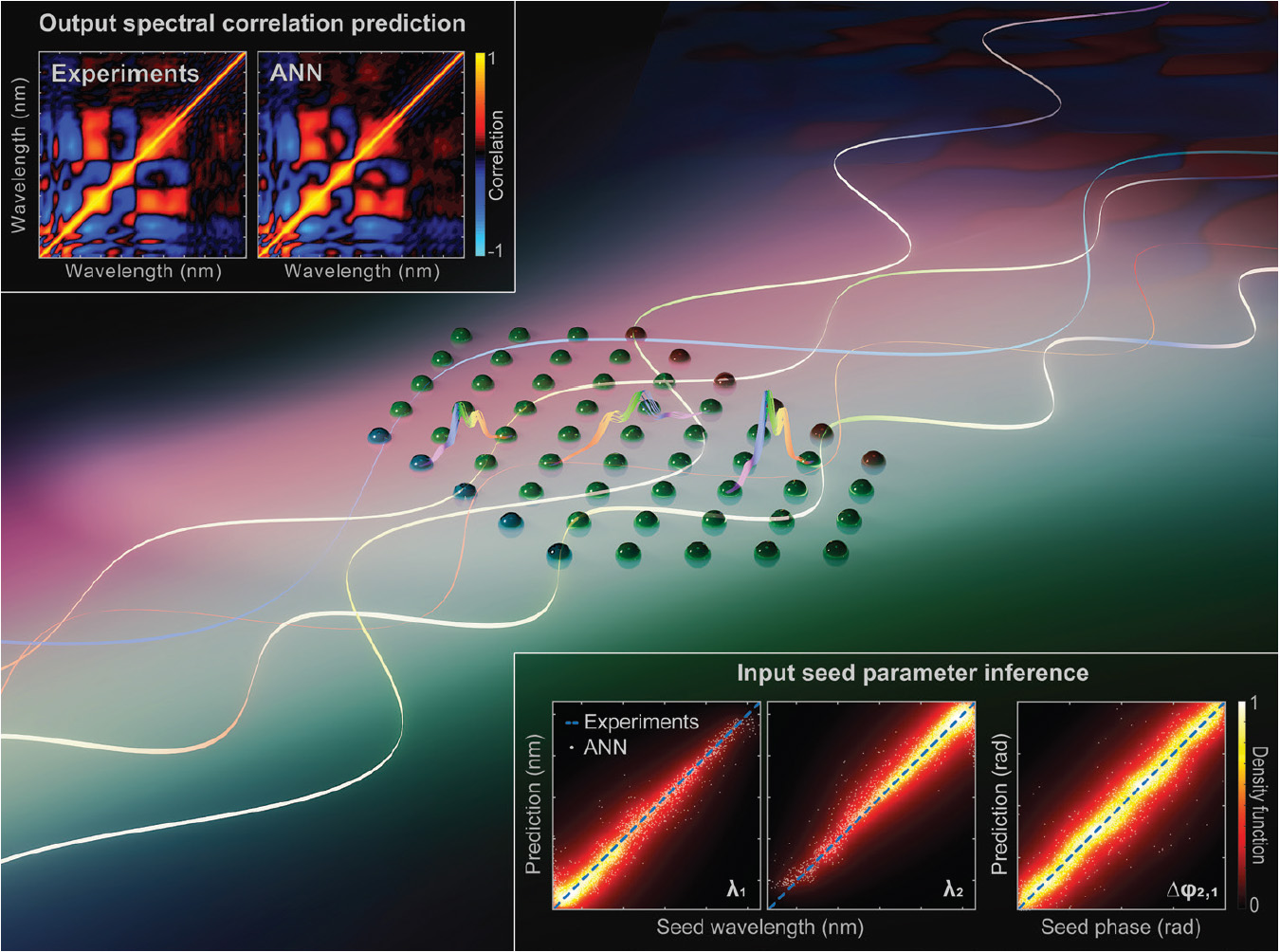
 [Enlarge image]Artistic view of an artificial neural network (ANN) modeling incoherent nonlinear fiber dynamics. Once trained, the ANN can reproduce experimental spectral correlations (top left) and retrieve hidden seed properties from noisy outputs (bottom right).
Noise-driven nonlinear instabilities are central to fiber optics, where random fluctuations can be exponentially amplified into complex patterns. A prime example is modulation instability, a process that drives nonlinear spectral broadening but remains notoriously difficult to predict due to its stochastic nature.1 Despite decades of study, the ability to decode and forecast such noisy nonlinear dynamics has remained elusive.
In our recent work,2 we show that artificial neural networks (ANNs) can predict and retrieve information from incoherent fiber dynamics, demonstrating that machine learning can forecast the statistical signatures of noise-driven nonlinear processes.
A major challenge for such systems is the reliance on real-time characterization to capture pulse-to-pulse fluctuations, as well as methods for controlling noise, which inherently shapes propagation. To address this, we previously developed advanced dispersive Fourier transform diagnostics3 and evolutionary seeding strategies,4 laying the foundation for the present work.
Here,2 we combine weak coherent seeding with ANN inference. Seeds more than 30 dB weaker than the pump compete with noise during propagation, leaving subtle fingerprints in output spectra and correlation maps. While hardly accessible to direct measurement, these features can be decoded by ANNs, which accurately infer hidden seed wavelengths and phases. The networks also predict statistical correlations within spectral fluctuations with errors of only a few percent compared with simulations or experiments.
The approach was validated through extensive simulations and real-time measurements, maintaining accuracy across tens of thousands of random seeding scenarios, even under realistic experimental conditions. Once trained, the ANN predicts statistical signatures directly from averaged data, alleviating the need for time-consuming Monte Carlo simulations or complex diagnostics.
Altogether, these results show that noise can be harnessed as a resource: Hidden input signal features can be retrieved from noisy outputs and incoherent signals tailored with dramatic speed-up by exploiting ANNs. This strategy spans regimes from nonlinear frequency conversion to photon-level quantum dynamics. Looking forward, it could be applied across diverse photonic platforms and even beyond optics, in other systems governed by the universal nonlinear Schrödinger equation5—highlighting the power of artificial intelligence to extract physics and shape dynamics from both noise and complexity.
Researchers
Y. Boussafa, L. Sader, V.T. Hoang, B.P. Chaves, A. Bougaud, M. Fabert, A. Tonello and B. Wetzel, XLIM Institute, CNRS - Université de Limoges, France
J.M. Dudley, Université Marie et Louis Pasteur and Institut Universitaire de France, France
M. Kues, Leibniz University Hannover, Germany
References
1. J.M. Dudley et al. Nat. Photon. 8, 755 (2014).
2. Y. Boussafa et al. Nat. Commun. 16, 7800 (2025).
3. L. Sader et al. ACS Photonics 10, 3915 (2023).
4. L. Sader et al. Nanophotonics 14, 2821 (2025).
5. F. Copie et al. Rev. Phys. 5, 100037 (2020).
