

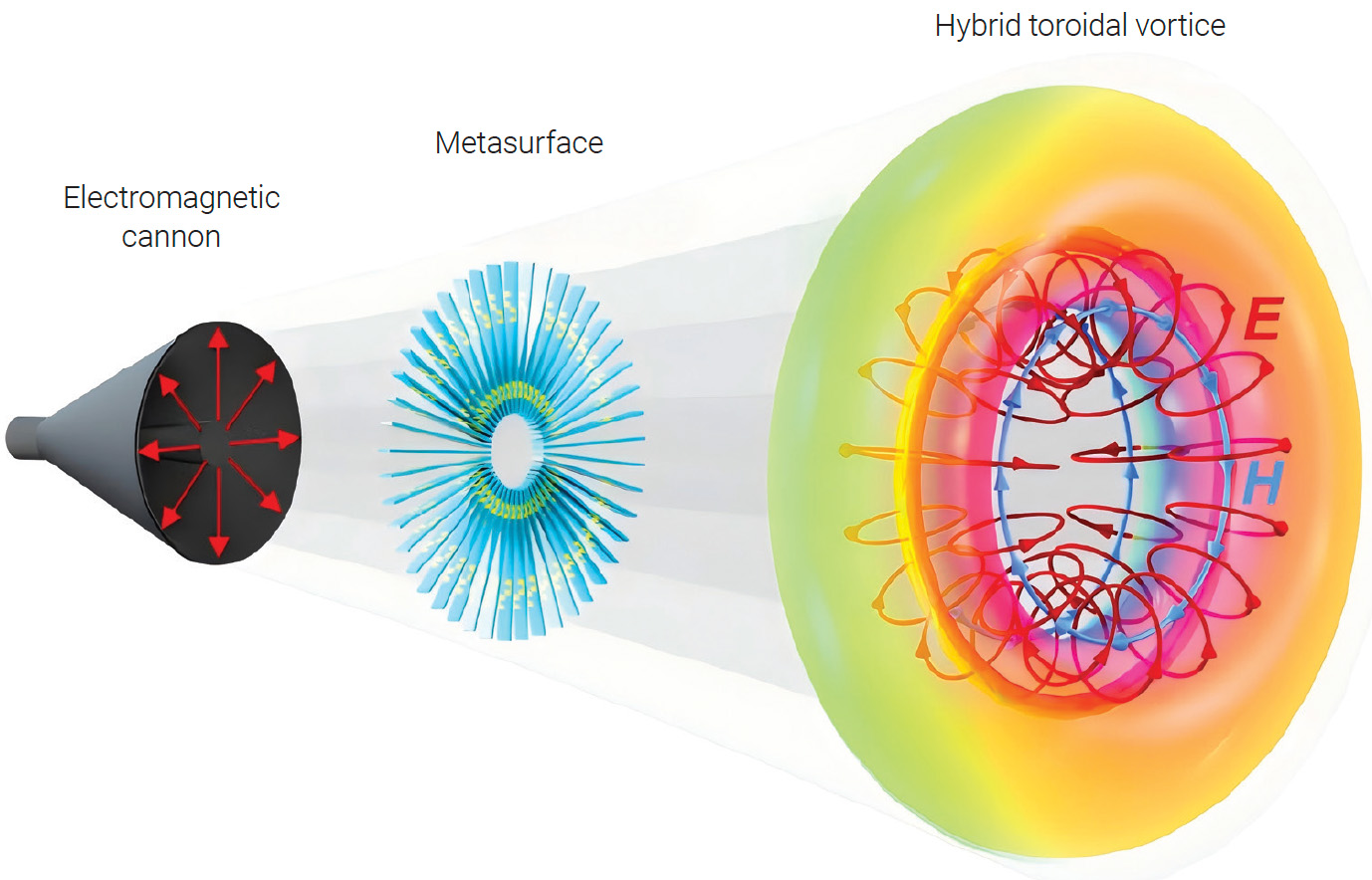
 [Enlarge image]Generation schematic of hybrid toroidal vortices.
What if a single pulse of light could carry multiple topological structures—each with its own exotic behavior—while still traveling at the speed of light? Recent breakthroughs in nanophotonics and structured light now make it possible to sculpt intricate topological patterns directly into light itself. These include spatiotemporal optical vortices (which twist in phase),1 toroidal vortices (with doughnut-shaped field lines),2 vortex streets (flow-like chains of singularities)3 and skyrmions (tiny, topologically stable whirlpools).4 Each of these topologies opens new directions in photonics—but until now, they have been generated separately, by different fields using different methods.
Our recent work changes that paradigm. We have proposed and demonstrated a new kind of light pulse, the hybrid toroidal vortex (HTV),5 that unites all four of these topologies into a single, structured electromagnetic pulse. This HTV starts as a radially polarized vector light. When passed through a specially designed symmetry-breaking metasurface, it transforms into a spatiotemporal vortex that carries orbital angular momentum.
But that’s just the beginning. These radially polarized fields naturally generate longitudinal components, creating a fully vectorial electromagnetic structure. At the heart of the pulse, interactions between polarization singularities form toroidal vortices—robust structures that resist distortion even in the four-dimensional spacetime domain of light. Over just a few wavelengths, these toroidal vortices interconnect to form an electromagnetic vortex street, a pattern never before observed in optics. Even more remarkably, skyrmion-like textures also emerge, linking this optical phenomenon to solid-state physics.
Why does this matter? By combining diverse topological features in one pulse, HTVs open up new possibilities for robust light-based communication, precision sensing and advanced light–matter interaction. Their inherent topological protection makes them resilient to disturbances, while their rich structure could excite exotic material responses, such as high-order toroidal multipoles or super-anapole modes. With their built-in orbital angular momentum and subwavelength skyrmion features, hybrid toroidal vortices are ideal candidates for high-capacity and robust optical networks and next-generation super-resolution sensing and imaging.
Researchers
Ren Wang, University of Electronic Science and Technology of China, China
Yijie Shen, Nanyang Technological University, Singapore
References
1. A. Chong et al. Nat. Photon. 14, 350 (2020).
2. A. Zdagkas et al. Nat. Photon. 16, 523 (2022).
3. Y. Shen et al. Nat. Commun. 15, 4863 (2024).
4. Y. Shen et al. Nat. Photon. 18, 15 (2024).
5. R. Wang et al. Sci. Adv. 11, eads4797 (2025).
