


Water attenuates long wavelengths of light, leading to the blue hues below the ocean's surface. [Image: DrPixel / Getty Images]
Water preferentially attenuates long wavelengths of light, leading to the blue hues familiar to scuba divers. This attenuation means that the undersea environment is not an ideal location for conventional solar cells, which are most efficient at collecting long wavelengths.
Researchers in China have developed specialized perovskite solar cells with wide band gaps customized to the blue-green spectrum of underwater regions (Joule, doi:10.1016/j.joule.2026.102672). The solar cells, modified with an organic polymer to convert the perovskites from p- to n-type, survived extended use in a simulated underwater environment and later supplying power to electronic devices submerged 10 m under the ocean surface.
“Very few studies have been reported on underwater solar cells, and all of them are focused on very shallow water depths of only two meters or less, a scenario far from catering for requirements of practical application,” says author Wen-Hua Zhang of Yunnan University and Southwest United Graduate School in Kunming, China. “This work presents the first functional validation of submerged solar cells practically operating at a water depth of up to about 10 meters, greatly broadening their application scope.”
Finding electricity under the sea
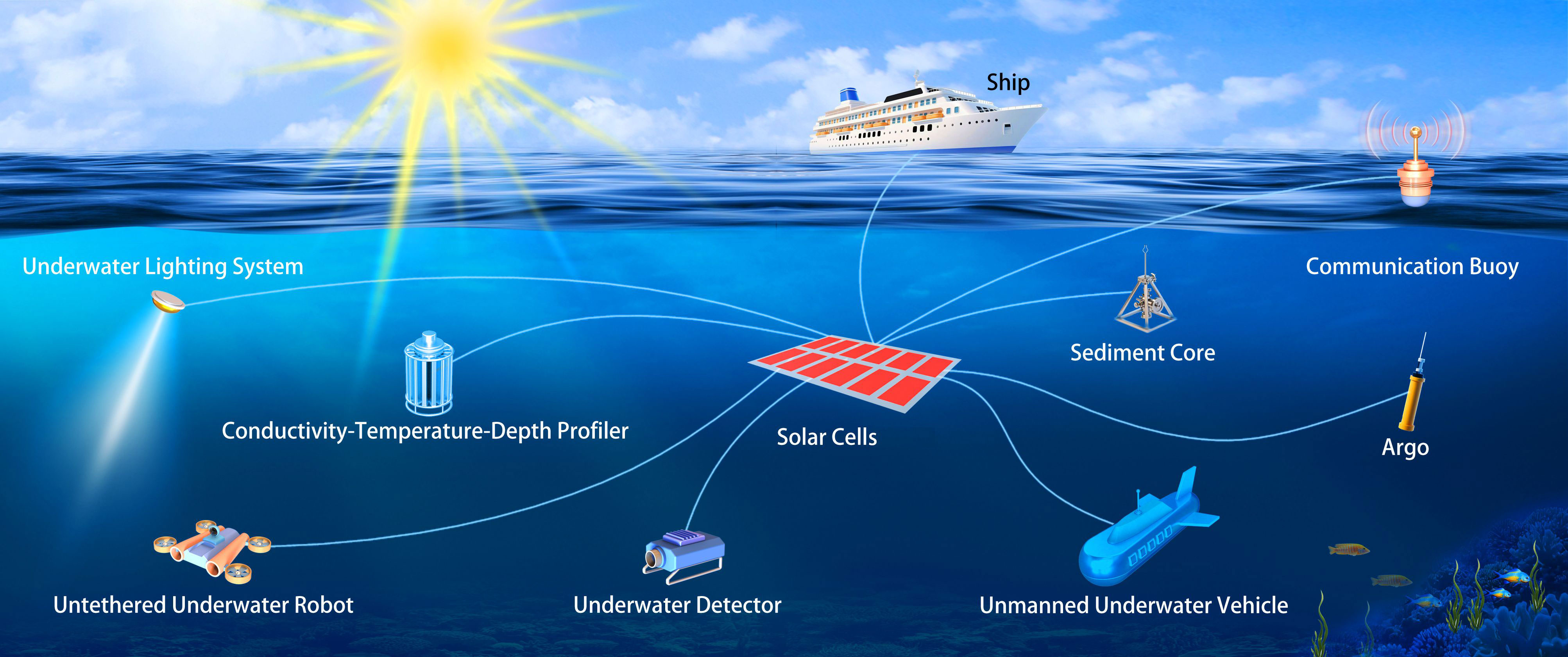
A schematic diagram of submerged perovskite solar cells for underwater applications. [Image: Simin Ma, Yunnan University]
Both human divers and autonomous devices require power for lighting, motors, cameras and other underwater equipment. Surface supply via electrical cable greatly limits the travel range of divers and robots, and batteries—even high-capacity versions—need to be recharged or replaced. While high-efficiency terrestrial photovoltaic panels, containing cadmium telluride or even conventional perovskites, harness wavelengths of 800 to 1150 nm to generate electricity, underwater solar cells struggle to operate because water strongly absorbs light with wavelengths at or above 630 nm.
In the new work, the team at Yunnan University fabricated a lead-based perovskite crystal modified with polyhexamethylene guanidine hydrochloride. The guanidine moieties interacted with the lattice structure of the semiconductor to improve the quality of the material’s lattice structure and widen the band gap to roughly 1.96 eV. An epoxy resin protected the cell from water damage.
Surprising amounts of energy
The researchers first tested the prototype solar cells above ground, but under lighting conditions simulating what the cells would “see” under varying depths of pure water (2, 5 and 10 m). The unit’s power conversion efficiency actually increased at greater mock depths, up to 34.71% at 10 m. The team also immersed the cells in tap water then tested the water to make sure that lead leakage from the cells was negligible.
Next, the Yunnan group tested the solar cells in real-world conditions off an island in the South China Sea. The team programmed an aquatic mini-robot to charge lithium-ion batteries with energy generated by the prototype cells. Even 10 m deep in seawater, the cells registered an output of 324 mWh. Retrieved from the water, the batteries lit up a small neon sign.
“What surprised us most was so much electrical energy our large-area modules generated under real-world conditions at 10-meter water depth for only two hours,” said Zhang.
Based on their tests, the Yunnan researchers predict that the perovskite solar cells will last more than 5 years of continuous operation at 25°C. The team will test the cells at greater depths to find their limit of underwater operation.
