


The gradual replacement of copper wiring with fiber optics is speeding up transmission between computers and other electronic devices. [Image: Getty Images/kynny]
While nonlinear optical processes, such as second-harmonic generation, are fundamental to integrated photonics, achieving wide-range electrical tunability within a truly nanoscale device has remained a challenge. Conventional electrically controlled nonlinear devices are relatively large and typically offer only modest tuning.
Now, researchers have demonstrated electrically tunable second-harmonic generation (SHG) in a novel device that reduces the dimensions from hundreds of nanometers down to only a few nanometers (Optica, doi: 10.1364/OPTICA.585277). They leveraged a plasmonic tunnel junction to produce strong SHG whose intensity could be tuned electrically with high reproducibility.
“The most direct applications are nanoscale light sources, reconfigurable optical modulators and detectors for integrated photonic circuits,” said study author Hayk Harutyunyan, Emory University, USA. “Beyond that, the nonlinear signal turns out to be a sensitive, nondestructive probe of charge motion inside the junction, so the device can report on ion or vacancy migration in real time.”
Confining light
Electric-field-induced second-harmonic generation has garnered attention as a promising approach for the development of electrically tunable nonlinear optical devices. However, previous platforms have been hindered by limited modulation depth, slow response time or requiring high optical or electrical power. To this end, Harutyunyan and his colleagues decided to explore the ability of plasmonic tunnel junctions.
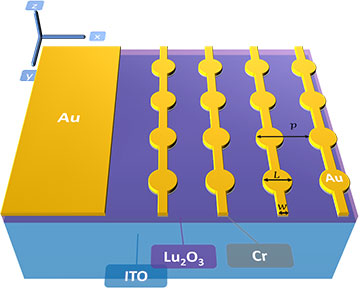
Schematic of the integrated component shows the gold electrodes and the base topped with an ultra-thin layer of lutetium oxide. [Image: Harutyunyan lab]
“We wanted to see whether a plasmonic tunnel junction, which confines light into a gap just a few nanometers wide while also acting as an electrical element, could close that gap and give us strong nonlinear signal together with wide electrical control in a single, very small device,” Harutyunyan said.
The researchers fabricated plasmonic tunnel junctions composed of epitaxial indium tin oxide and plasmonic gold electrodes separated by an epitaxial lutetium oxide barrier on yttria-stabilized zirconia substrates. Upon excitation with a femtosecond laser, the epitaxial heterostructures achieved modulation of SHG with depths of roughly 500% and magnitudes above 1.3 V−1.
Dual mechanisms
A major obstacle in the field has been that most metal-insulator-metal tunnel junctions degrade or short out under the bias fields needed for tuning. Notably, the epitaxial structure in the current study remained exceptionally stable under voltage and gave highly reproducible results. Harutyunyan and his colleagues identified two modulation mechanisms, electric-field-induced SHG and ion migration, that can either compete or cooperate depending on junction thickness and bias.
“A key open question is speed. We expect the ion-migration response to fall in the nanosecond to microsecond range, but measuring those dynamics directly is beyond the resolution of our current setup, so building the capability to probe them is a clear next step,” Harutyunyan said. “Beyond that, we want to push toward integrating these junctions into functional photonic circuit elements and to explore their use for neuromorphic optical computing and quantum light control.”
