

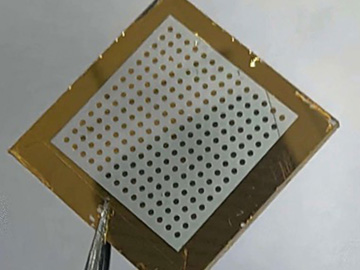
An adaptive optical device could help autonomous machines to recognize objects in complex and dynamic lighting conditions. [Image: Jia Zhu/Penn State]
An international team of researchers has created an artificial eye that can react to changing light conditions within just a few seconds (Nat. Commun., doi: 10.1038/s41467-026-73217-7). The visual system, which combines an adaptive optical device with a neural network to mimic the mechanics of the human eye, can accurately identify objects in environments that include both bright light and dark shadow.
Limited by light
Self-driving cars and autonomous robots typically exploit advanced cameras and complex algorithms to navigate their surroundings, but existing systems struggle to maintain reliability in diverse or dynamic light conditions. Neuromorphic devices inspired by the networks of neurons and synapses in the human brain offer a promising solution. Previous designs, however, have not been able to provide the required visual accuracy in a practical system.
These neuromorphic systems replicate the memory function of a synapse using electronic components called memristors, which store information through a reversible change in their physical state. An optical memristor can both sense light and “remember” that it has been illuminated, but these devices have previously been calibrated and optimized for constant light conditions.
A more adaptive design
To create a more adaptive design, the researchers fabricated a layered device that includes two functional materials. A layer of photosensitive titanium dioxide first converts incoming photons into charge carriers, which drive a response at the interface with a conductive plastic called PEDOT:PSS. This plastic has a gel-like consistency, with the intensity of light changing its conductivity by altering the amount of water that the material absorbs from the surrounding environment.
Bright light causes the plastic to lose water, which suppresses the material’s conductivity and reduces the sensitivity of the device to powerful light sources. In dim conditions the plastic can absorb more water, which increases its conductivity and enhances its response to weak optical signals. “This key design difference allows us to dynamically adapt to changing light conditions,” said Larry Cheng, Penn State University, USA.
Tests show a clear difference in the response of the new device to the intensity of ultraviolet light. At low light levels, the current produced by the photomemristor gradually increases until it reaches saturation. At higher intensities, the output first increases to a maximum and then rapidly falls to a much lower level, showing that the conductivity of the PEDOT:PSS layer has been suppressed.
Demonstration and next steps
In a proof-of-concept demonstration, the team created an artificial visual system by integrating a 4 × 4 array of the photomeristors with a neural network. In one test, the top half of the array was kept in dark conditions, while the lower half was exposed to bright light. When different letters formed from LEDs were placed in front of the array, the system could identify the letter patterns with an accuracy of up to 93.7% after a processing time of just 7.5 seconds.
Cheng says that the simple device structure can be fabricated at scale, and its small size allows for easy integration into practical solutions. The team now plans to incorporate the photomemristors into a multi-modal sensing system for autonomous machines.
