

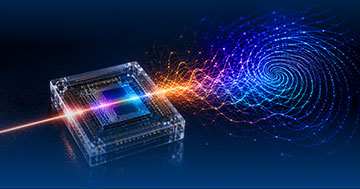
A conceptual rendering of KAUST’s new authentication technology, which combines laser-generated physical fingerprints and AI to verify the identity of connected devices without traditional passwords or security keys. [Image: KAUST]
The rapid growth of cloud computing, artificial intelligence and the internet of things presents a growing security challenge. Authentication must support many users and devices that are constantly joining, leaving and exchanging information. Traditional security systems that use static keys such as passwords struggle to keep up with these dynamic demands and remain vulnerable to key leakage and backdoor attacks.
Now, researchers at the King Abdullah University of Science and Technology (KAUST), Saudi Arabia, have developed a security system—based on chaotic vertical-cavity surface-emitting lasers (VCSELs)—that offers scalable, real-time authentication (Nat. Electron., doi: 10.1038/s41928-026-01627-y).
“As artificial intelligence and cloud services continue to expand, there is growing interest in new approaches to digital security that can operate at large scale,” said study author Yating Wan. “This work demonstrates how photonics and artificial intelligence can be combined to address that challenge.”
A laser-based PUF system
Over the past decade, physical unclonable functions (PUFs) have emerged as an alternative to conventional static key management systems. A PUF is a physical object that generates a unique, unpredictable output or “response” when presented with a specific input or “challenge.” By leveraging these unique challenge-to-response mappings, PUFs enable secure key generation and authentication rooted in the device’s intrinsic physical properties.
“However, many existing systems produce keys relatively slowly and become difficult to scale when a large number of keys is required,” Wan said. “Our motivation was therefore to develop a compact hardware system that can continuously generate fresh, unpredictable security keys at very high speed and verify them in real time.”
To this end, Wan and her colleagues created a chaos-based PUF security system consisting of a chaotic VCSEL array with bias-control configuration. No two lasers are exactly alike due to inherent random variations introduced during fabrication. The chaotic dynamics amplify these differences, giving each device a distinctive response and selecting different lasers or adjusting their injection current and temperature creates additional response states.
High-speed key generation
To authenticate a device, the system selects a particular laser and sets its current and temperature. This combination represents the challenge, and the resulting chaotic emission constitutes the response. Security keys are extracted directly and continuously from these ultrafast optical dynamics, removing the sequential bottleneck and enabling key generation at very high speeds.
The researchers developed a compact AI model to determine whether a key matches the activated target challenge with near-zero false positive rates. In laboratory testing, the system generated response rates above 500 Gbps with an energy consumption below 1 pJ per bit per laser emitter.
“The next major step is to turn these components into a complete packaged module,” Wan said. “Finally, the complete system should be evaluated in practical cloud, edge-computing and internet-of-things environments, where it could provide dynamically generated hardware security keys for large numbers of users and connected devices.”
