

José Azaña (left) and Benjamin Crockett (right) in their laboratory at the Institut national de la recherche scientifique (INRS), Canada. [Image: INRS]
For many quantum technologies, background noise can be a major issue that limits their out-of-lab deployment. For example, advances in quantum networking that have enabled secure communications, clock synchronization and optical quantum computing largely require strict conditions to minimize noise.
Now, researchers based in Canada and China have developed a noise-mitigation technique that not only recovers entangled states buried in noise but also improves their properties (Sci. Adv., doi: 10.1126/sciadv.ady8981). The approach has important applications for quantum communications, where excess noise from classical signals can prevent a quantum link from being established.
“With this new methodology, we were able to recover quantum states corrupted by large amounts of noise—states that would otherwise have been lost,” said study author Benjamin Crockett, University of British Columbia, Canada. “This could allow quantum systems to operate under real‑world noise conditions, helping overcome one of the major barriers to the practical deployment of quantum technologies.”
Starting with classical signals
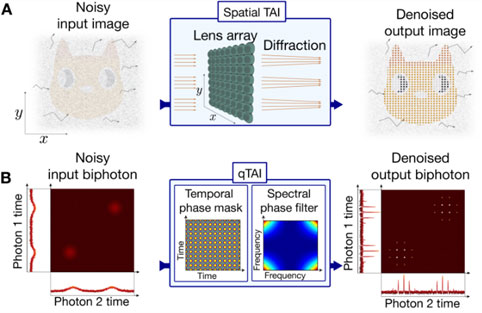
A. To make an image corrupted by noise readable you can pass it through a series of lenses. These lenses redistribute the image: Instead of a blurry picture, it becomes a set of well‑defined points.
This transformation makes it easier to extract the meaningful information. This principle can be applied in time as well.
B. We can use a temporal equivalent of this imaging system to reorganize photon correlations over time. The correlations are redistributed into a series of distinct temporal points, making them much easier to analyze despite noise. [Image: INRS]
Previously, Crockett and his colleagues demonstrated a similar technique for classical signals that could enable the full recovery of arbitrary ultrafast waveforms buried under noise, in a real-time and single-shot fashion.
The basic principle relies on a spectral implementation of the Talbot array illuminator (TAI), a lossless method of focusing a uniform beam into an array of bright spots. Implementing TAI along the frequency spectrum representation of a temporal waveform results in a sampled version of the input spectrum, while the incoherent noise content is left untouched. In this way, the spectral TAI mechanism can denoise the waveform of interest even when the signal is totally buried under noise.
“The aspect about this scheme that really differentiated it from other noise-mitigation schemes is that it was inherently a very energy-efficient scheme that could ‘pick out’ the signal of interest by focusing it into peaks,” Crockett said. “The idea of translating this to the quantum domain made the whole study really interesting.”
Reviving the entangled state
In the current work, the researchers performed TAI in the time domain to show noise mitigation of correlated infrared biphotons. They employed an electro-optic phase modulator and linearly chirped fiber Bragg grating—for quadratic temporal phase modulation and quadratic spectral phase filtering, respectively—to compress the coherent part of their 2D temporal distribution into short peaks that follow the envelope of the original waveform.
Due to its lower coherence, the background noise does not focus into these peaks, which enables the revival of the entangled state that would have otherwise been lost. Crockett and his colleagues are further developing the technique, such as increasing the efficiency of the focusing process and miniaturizing the denoising module, to improve its suitability for field trials.
“One important application for this technique would be for quantum communications, where co-propagating classical signals in fiber networks or illumination from the sun in satellite communication inject a large amount of noise that inhibits a quantum link from being established,” Crockett said. “Using regular optical filters, it is difficult to reach denoising bandwidth below a few GHz, whereas using this approach, we can reach bandwidth in the hundreds of MHz, and potentially even narrower, which allows to remove a significant amount of noise.”
