

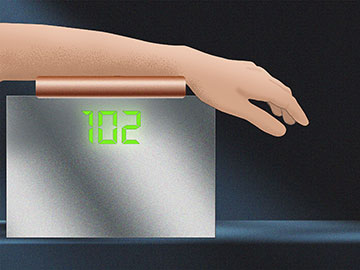
A noninvasive blood glucose monitoring method developed at MIT could spare diabetes patients from frequent finger pricks and potentially replace traditional techniques. [Image: Christine Daniloff/MIT]
People with diabetes need to check their blood glucose levels frequently, but no one likes sticking needles into their fingers. Even today’s much-touted continuous glucose monitoring (CGM) systems rely on tiny needles that can irritate the skin.
Now, researchers in the United States and the Republic of Korea have developed a prototype glucose monitor that employs near-infrared light instead of sharp metal points (Anal. Chem., doi: 10.1021/acs.analchem.5c01146). The bandpass Raman spectroscopy system filters out noise and background variations, and in preliminary trials, it collected the spectral signal of glucose with metrics comparable to commercially available CGM sensors.
Focusing on certain spectra
The team based at the Massachusetts Institute of Technology (MIT), USA, began by setting up a full-spectrum Raman spectrometer to collect spectra of various “tissue phantoms,” or solutions, containing various mixtures of glucose, lipids and salt. The researchers, including scientists from biotechnology company Apollon Inc., Republic of Korea, focused on the spectral region from 600 to 1800 cm–1, surrounding the most prominent feature of glucose at 1125 cm–1. The data helped the team refine the customized filters targeting the most useful parts of the glucose Raman spectrum.
“By refraining from acquiring the whole spectrum, which has a lot of redundant information, we go down to three bands selected from about 1,000,” says MIT researcher Arianna Bresci. “With this new approach, we can change the components commonly used in Raman-based devices, and save space, time and cost.”
The actual monitoring device includes a collimated laser beam at a wavelength of 830.35 nm and a 170-μm-thick quartz window. The beam passes through the window at an incidence angle of 60° to minimize confusing reflections. Various long-pass and narrow-pass filters select the desired wavelengths to reach the silicon photoreceiver. The research group thus avoided the use of bulky gratings and a CCD camera, although the device is roughly the size of a shoebox—too large to be worn for continuous monitoring.
Testing the device
In human tests, the subjects rested their arms on the window on the top side of the proof-of-concept device. The laser light hit a patch of skin roughly 0.5 × 1 mm in size. The team took blood-glucose measurements of the subjects before and after drinking sweet solutions and compared the prototype’s results with both finger-stick glucometer tests and current CGM devices.
The researchers are now working on shrinking the size of the spectroscopic device and refining it to accommodate different human skin tones.
“For a long time, the finger stick has been the standard method for measuring blood sugar, but nobody wants to prick their finger every day, multiple times a day. Naturally, many diabetic patients are under-testing their blood glucose levels, which can cause serious complications,” says study author Jeon Woong Kang, Massachusetts Institute of Technology (MIT), USA. “If we can make a noninvasive glucose monitor with high accuracy, then almost everyone with diabetes will benefit from this new technology.”
