

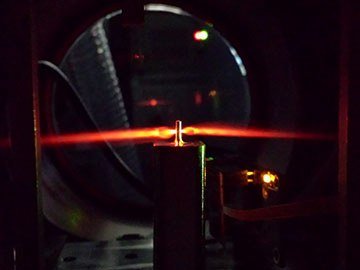
Ultrashort laser pulses interact with a neon gas jet to generate attosecond pulses. This interaction initiates high-harmonic generation, yielding the shortest attosecond soft X-ray pulse ever produced. [Image: ICFO]
Scientists at a laboratory in Europe have produced an isolated soft X-ray pulse with a duration of only 19.2 attoseconds (Ultrafast Sci., doi:10.34133/ultrafastscience.0128 ). The high-harmonic generation tabletop experiment could unlock new details about electron dynamics in organic molecules and other materials.
Capturing the ultrashort flash
The result is not only the shortest X-ray pulse ever demonstrated, but it also fits within the so-called “water window,” in which water is transparent to the X-ray part of the spectrum. The pulse is also shorter than the atomic unit of time, roughly 24.2 as, a fundamental unit in atomic physics calculations.
Creating and measuring the attosecond pulse required the team at the Institute of Photonic Sciences (ICFO), Spain, to develop both the pulse-generation hardware and the metrology algorithms to evaluate an occurrence happening at such a brief time scale.
The researchers’ laser system starts with an Nd:YAG pump laser feeding into a cryogenically cooled Ti:sapphire amplifier. A gas-filled hollow-core fiber spectrally broadened the pulses from that part of the system before the pulses were recompressed into stable 12-fs pulses. A pellicle mirror split that beam, directing part into the soft X-ray generation region and part through a delay line to act as a streaking field.
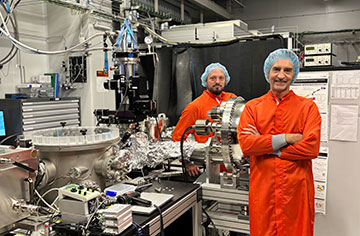
Fernando Ardana-Lamas (left, rear) and Jens Biegert (right, front) in the attoscience laboratory at ICFO. [Image: ICFO]
For the light to reach the soft X-ray region, the team focused the pulses onto a spot only 54 μm wide inside a T-shaped target filled with neon to a pressure of 3.5 bar. A time-of-flight spectrometer captured data from the beams, and the ICFO group, led by Optica Fellow Jens Biegert and his colleague Fernando Ardana-Lamas, used the Volkov-transform generalized projection algorithm to process the data and characterize the pulse output of the experiment.
Details of the results
The ICFO group repeated the experiment 30 times for an average pulse duration of 19.2 as. The coherent pulses were centered at 243 eV and exhibited a photon flux of 4.8 × 10¹⁰ photons per second.
“This new capability paves the way for breakthroughs in physics, chemistry, biology and quantum science, enabling direct observation of processes that drive photovoltaics, catalysis, correlated materials and emerging quantum devices,” Biegert said in a press statement.
