

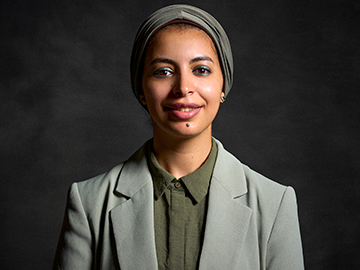
Benelajla. [Image: Courtesy of Meryem Benelajla]
I recently gave an Optica Career Trajectories webinar, and I opened with an idea that caught a few people off guard: Technology and careers have more in common than we think. Neither follows a straight line. Both are shaped by unexpected turns, difficult pivots and moments when you have to decide what to do with what you have.
We often talk about careers as if they were carefully designed trajectories: study, specialize, build expertise, move into the next role and keep climbing. Technology is often described in much the same way, as a sequence of breakthroughs that gradually take us from one solution to the next. But that is rarely how either actually works.
The most meaningful progress often happens when the original plan stops working. A new question appears. An unexpected opportunity opens up. Something you thought was a setback forces you to look at your skills, your direction or even your identity differently. That was certainly true for me.
The questions I received after the webinar made that clear. They were rarely about nano-optics.
They were about something much more personal: How do you make the leap? How do you move from academia to industry without losing what makes you valuable? How do you recognize when it is time to change direction? And how do you build a career around something bigger than the next job title? Those questions are worth exploring because career transitions are rarely just about changing jobs.
They are moments when you have to rethink how you see yourself, and what you believe you are capable of building next. So here, I want to take the idea a little further by looking at my journey through both lenses: the technology I have spent years building and the career path that brought me here. Because, surprisingly, they follow a very similar logic.
The technology: splitting light, not wasting it
Let me start with the technology because it serves as the foundation for everything else.
For 50 years, every camera has captured color the same way: using red, green, blue color filters that work by absorbing light. For example, a red filter blocks green and blue light, meaning most of the light hitting each pixel simply dies before it can ever be measured.
To try and capture more light, the industry has spent decades building bigger, more expensive sensors. At eyeo, we took a completely different approach: we don't filter light, we split it. Using nanophotonic structures, we guide each color directly to its pixel instead of throwing it away. This allows us to capture three times more light in the same sensor size.
At its core, it comes down to one simple idea: “Stop wasting what you're given, and direct it, on purpose, where it needs to go.” That single sentence turned out to describe my career, too.
The pivot nobody prepares you for
My path ran from academia, to industry, to business, and the hardest part was never the technical work.
When my postdoc wrapped up, I faced a question my Ph.D. hadn't prepared me for: Should I stay in academia and start over, or follow the technology I had spent years shaping out into the real world? I chose the second option. To make it happen, I did something that genuinely terrified me: I started an MBA. The most valuable part of that experience was being forced to confront a deeply personal question: Who am I and what value do I bring beyond my Ph.D. title?
Every career transition has a low point. Mine came right after my doctorate, the moment the academic safety net fell away, and I realized a title alone wouldn't define my future. If you are near that point right now, I want to share what I wish someone had told me back then:
“The dip is not a detour. It is the path... When life throws you lemons, make a lemon pie.”
The curve is not what you imagine
I used to picture my career as a smooth, predictable path, a quiet start, a sweet spot, and a steady climb up and to the right.
The reality looked nothing like that. It was a series of connected curves, each bringing its own doubts and breakthroughs. When I mapped my journey onto the change curve, the same framework that companies use to track how people handle major transitions, it fit remarkably well.
Everything changes when you reach alignment: the point where your daily work, your identity and your overarching purpose finally point in the same direction. Once you reach that space, your mindset flips. You stop fearing the next transition and start treating each one as a launchpad to jump higher. For me, getting there came down to five core questions I call the 5Fs framework:
• Find yourself: Discover who you are beyond your job title.
• Find your strength: Identify what you uniquely bring to the table and own it.
• Find your people: Surround yourself with the mentors, sponsors and allies who lift you up.
• Find your authenticity: Let your genuine self show and develop a leadership voice grounded in who you are and what you stand for.
• Find your purpose: Look beyond your job to discover the vision and impact you want to pursue.
Five simple questions, and I had to live every single one.
The most underrated asset in your career
If I could leave early-career researchers with one key insight, it would be this: Your network is your most underrated asset, and you build it by being visible, not by waiting to be discovered. In the language of the Johari window model, most of us keep too much of ourselves in the “hidden area.” Sharing your strengths and letting people know what you are genuinely good at isn't bragging; it's simply being visible.
Mentor the people a few steps behind you. Contribute to your community. Show up. I always made a point to do this, and it is exactly how my next opportunity found me: not through an open job posting, but through someone who already knew my value.
There is a founder's habit hidden in all of this. You don't wait until you are officially a leader, fundable, or “ready.” Instead, you project yourself into the role first, imagining the person already doing that work, and then work backward:
• What skills do they have that you need to build?
• What does their network look like?
That gap becomes your personal roadmap, and self-awareness is the engine that closes it.
A shared goal
Seeing the values I cared about most, trust, collaboration and excellence, reflected at eyeo, joining the team didn't feel like a scary leap into the unknown. It felt like coming home to a place that happened to be building the future.
What made the transition meaningful was not simply finding a company whose values matched mine. It was finding a place where my own ambitions could contribute to something bigger. I had spent years thinking about what I could build as a scientist; now I could think about what we could build together.
That, for me, is the real power of alignment. The right opportunity doesn't just fit your experience; it connects your strengths and your ambitions to a shared vision. And when that happens, a career transition stops feeling like leaving something behind and starts feeling like moving toward something.
If you are navigating your own crossing from academia to industry, I would love to hear your story and share the career compass I built for this exact journey.
And whatever you are building today, a new technology, a rewarding career, or both, don't forget to enjoy the ride along the way.
Reference:
M. Benelajla, “My 5F Leadership Formula: A Way of Growing Without Losing Yourself in STEM [Career Advisor],” *IEEE Women in Engineering Magazine*, vol. 20, no. 1, pp. 26–36, June 2026, doi: 10.1109/MWIE.2026.3672059.
Meryem Benelajla is the Photonics Characterization Lead at eyeo, where she designs the imaging systems of the future. A global expert with experience across Europe and the United States, she combines an industrial Marie Curie Ph.D. in photonics with an Executive MBA to bridge the gap between high-level science and business strategy.
