

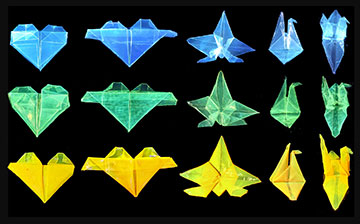
A new type of carbon dot can fluoresce in different colors and can be combined with polymers to create foldable plastic films. [Image: Adapted from ACS Cent. Sci., DOI: 10.1021/acscentsci.6C01482]
A research team in China has created fluorescent nanoparticles that emit different colors when their local conditions change (ACS Cent. Sci., doi: 10.1021/acscentsci.6c01482). Thin films made from the carbon-based nanoparticles were shown to fluoresce brightly at four distinct wavelengths, potentially providing a more secure way to encode information for data protection and anti-counterfeiting technologies.
Brighter dots
Carbon dots are known for their ability to fluoresce brightly at visible wavelengths when they are exposed to ultraviolet light. These nanosized structures have a carbon-rich core surrounded by an outer shell of surface molecules, which can modify the output color when they react to external stimuli. However, previous attempts to dynamically alter the light-emitting properties of the dots have yielded only a small shift in the wavelength and have also weakened the fluorescent response.
In this new work, the researchers synthesized carbon dots from two precursor compounds that support bright light emission from the carbon-based core. These two precursors also imbue the surfaces of the dots with functional groups that respond to changes in their chemical environment, offering several different ways to alter the output color.
When the dots were suspended in a liquid, tests showed that they fluoresced red in acidic conditions and green in an alkaline solution, with the color change reversing repeatedly in response to the pH level. Color shifts were also observed when the nanoparticles were dispersed in different solvents—such as water, toluene, methanol or ethanol—and for different dot concentrations.
Changing colors
The researchers found that changing the ratio of the two precursors altered the light-emitting properties of the nanoparticles. One variant produced colors between yellow-green and orange-red with an efficiency approaching 100%, while a second version extended the wavelength range into the blue region but with slightly lower efficiencies.
The carbon dots were also mixed with polymers to create solid powders and thin films that fluoresce at blue, green, yellow and red wavelengths. These solid materials were used to coat decorative objects, while the different colors emitted by the fluorescent films were also exploited to encode simple text messages.
As a further proof of concept, the team used the carbon dots to construct a multi-level encryption system. Information was encoded in a 6 × 8 grid by varying the initial conditions and then subsequently exposing the dots to either UV light or sunlight or treating them with an acid. In one example, this approach enabled fragmented data from four display channels to be integrated into a single complete password. “This offers a new approach to designing smart optical materials that can sense their surroundings and convey information,” said Siyu Lu of Zhengzhou University.
