

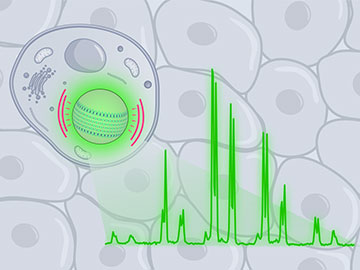
Researchers developed tiny flexible lasers that change emission properties in response to external force, allowing them to be used inside living cells to measure forces in and between cells. [Image: Marcel Schubert, University of Cologne]
In the last decade, whispering gallery mode (WGM) lasers have been used to track cell migration and sense cellular forces, highlighting their growing utility as a biosensing tool. WGM lasers work by optically pumping dye molecules embedded in an otherwise transparent microsphere, where the light circulates and amplifies until it emits coherent light.
Now, researchers at the University of Cologne, Germany, have created a new type of flexible WGM microlaser out of a commercially available elastomer material that can measure the minuscule forces inside living cells (Opt. Mater. Express, doi: 10.1364/OME.600106).
“The applications we see are related to force measurements in clinically relevant cell models, primarily in stem cell‒derived heart organoids,” said study author Marcel Schubert. “In addition, labs that are studying the development of embryos or specific organs can benefit from our technique, as it can be applied deeper inside biological tissue than many other techniques.”
Solid yet deformable
Schubert’s lab, part of the Humboldt Centre for Nano- and Biophotonics, focuses on the development of new tools in biointegrated photonics to study complex biological processes. For several years, the researchers have been working on building soft microlasers for measuring the forces of single cells and inside organoids. Force sensing is derived from shifts in the emitted laser spectrum that result from deformation of the microlaser.
Their previous WGM lasers used oil droplets as the transparent microsphere, but such liquids proved too soft for many types of force measurements. They needed a new material that was solid yet deformable. “Our new microlasers are made from a silicone-based elastomer—essentially, a very soft gel,” said Schubert. “It has a relatively high refractive index, which allows it to efficiently trap light by total internal reflection.”
To fabricate the microlasers, they used a microfluidic chip and commercial two-component silicone gel to produce elastomer microbeads with adjustable diameters ranging from 8 to 30 µm. When doped with an organic dye, the microbeads emitted narrow WGM lasing spectra with low lasing thresholds. An atomic force microscope was employed for mechanical characterization, revealing a Young’s modulus comparable to that of soft biological tissues.
Next steps
Finally, tests in live cell cultures demonstrated that the microlasers remained stable for several days. Possible applications include force sensing in strongly contracting organs and tissues such as mammary glands, the heart or smooth muscles. The elastomer-based microlasers can also be leveraged for deep-tissue force sensing experiments where image-based techniques cannot be used.
In the near future, the researchers plan to make further improvements to the microlaser, such as reducing its overall size. “This requires us to find elastomers that have even higher refractive indices but maintain their very soft mechanical properties,” he said. “Especially for in vivo applications, we also need to improve the long-term stability and optimize the synthesis to improve the precision of the method.”
