

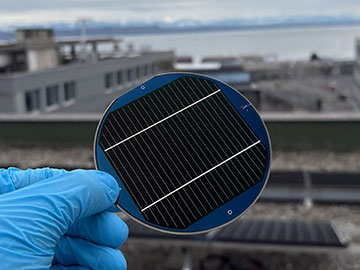
The triple-junction solar cell (54 cm2). [Image: Kerem Artuk]
An international team of researchers has developed a perovskite-silicon triple-junction solar cell that achieves a record certified efficiency of 30.02% (Nature, doi: 10.1038/s41586-026-10385-y). The device, composed of a silicon bottom cell and thin-film perovskite middle and top cells, surpasses the previous record of 27.1%.
“Our first demonstration in 2018 had only 13% efficiency, so reaching over 30% efficiency today in a triple-junction device is a remarkable achievement,” said study author Christophe Ballif, EPFL, Switzerland, in a press release accompanying the research. “Triple-junction solar cells have an even higher efficiency potential compared to single junction and tandem—well above 40%.”
The next frontier
Since 2015, perovskite-silicon tandem solar cells have emerged as a leading solution for surpassing the efficiency limits of traditional single-junction silicon solar cells. The devices have reached a certified power conversion efficiency of up to 35%, meaning they are quickly approaching their practical target of 37.8%. With a theoretical efficiency limit of 51.8%, triple-junction solar cells are poised to become the next major advancement in photovoltaic technology.
Previous triple-junction devices have been limited by high nonradiative losses, phase segregation and constrained current matching. The current study addresses these limitations by improving the bulk quality of the wide-bandgap perovskite absorber and leveraging photon management to increase the current density in the middle cell.
Ballif and his colleagues added an arylamine-based 4-HBA additive to the thin-film perovskite that modulates crystallization, reduces phase segregation and suppresses nonradiative recombination. They also developed a hybrid three-step deposition method to fabricate a middle cell that improves near-infrared light absorption. Finally, the researchers introduced a low-refractive-index middle reflector at the perovskite/silicon interface, which reflects part of the transmitted light back into the middle cell, increasing absorption near its band edge.
On par with space-grade devices
After in-house measurements, two devices were submitted for certification and achieved stabilized certified efficiencies of 30.02% and 29.76%, with reverse-scan efficiencies of 30.44% and 30.18% and open-circuit voltages exceeding 3.2 V.
“We show that with clever design and processing, we can approach performance levels traditionally reserved for the most expensive III–V multi-junction solar cells used in space, which are composed of multiple semiconductor layers. These can reach up to 37% efficiency, and cost around 1,000 times more than terrestrial cells per watt,” said study author Kerem Artuk, a former graduate student at EPFL, in a press release accompanying the research. “Our approach opens the door to a new generation of industrially viable, high-efficiency multi-junction photovoltaics.”
