

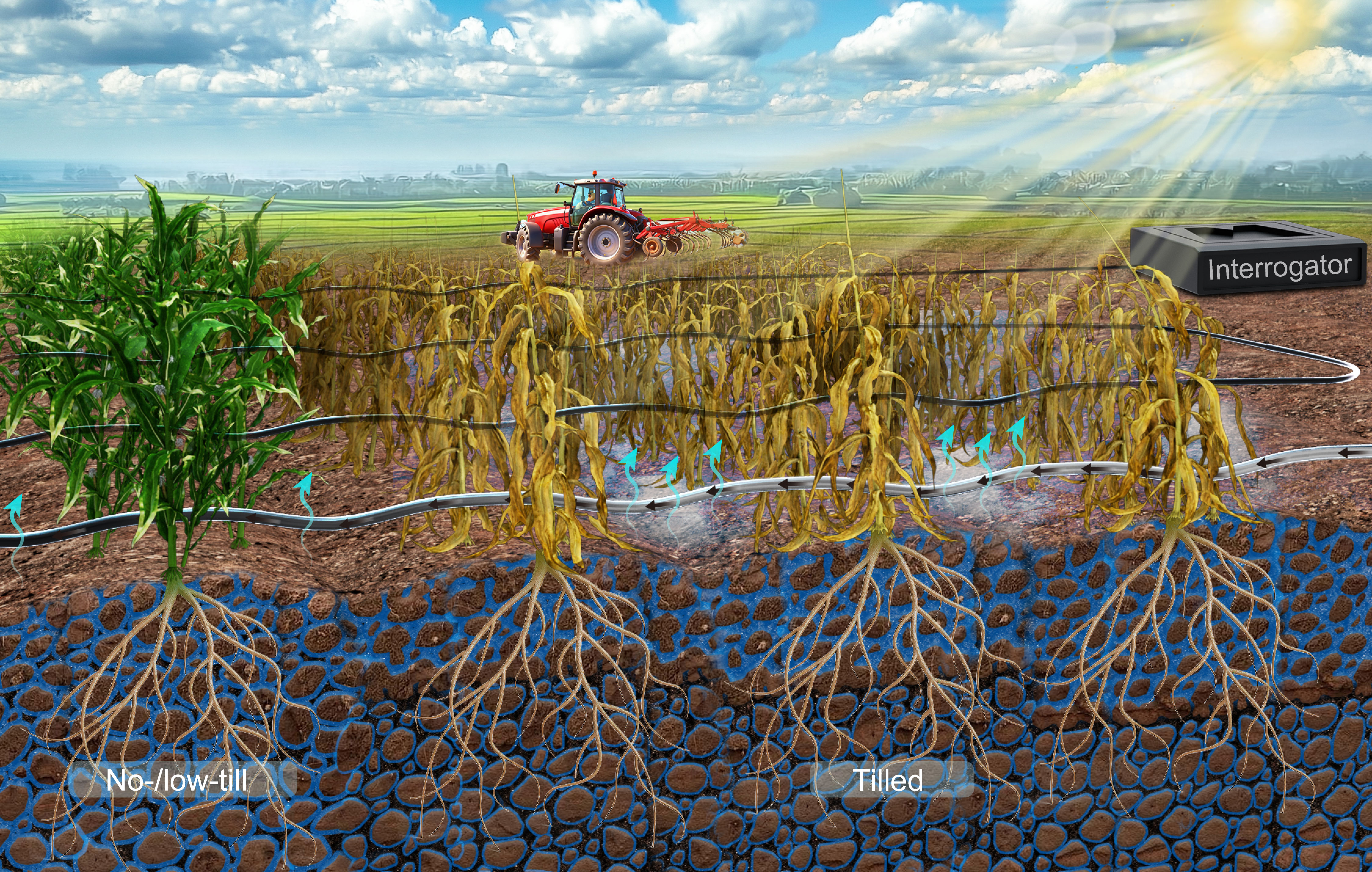
Impact of farming practice on the porous structure of soil and hydrological processes revealed by distributed acoustic sensing. [Image: Institute of Geology and Geophysics, Chinese Academy of Sciences]
As every farmer knows, good agriculture starts with good-quality soil. Unbeknownst to most observers, soil is not just static dirt, but a dynamic network of subsurface pores and hydrological channels that can help or hinder plants’ ability to access water.
An international research team led by the Chinese Academy of Sciences (CAS) used optical-fiber cables as distributed acoustic sensors to study the seismic and hydrodynamic patterns of soil that has been repeatedly tilled and compacted (Science, doi: 10.1126/science.aec0970). Not only did the scientists find that undisturbed soils retain water at greater depths than repeatedly plowed ground, but the group also demonstrated the feasibility of using embedded optical fibers to monitor underground moisture redistribution and evaporation.
Soil: dynamic, not static
Although processes in both biology and surface geology shape the natural structures of the soil layer that sits between Earth’s atmosphere and bedrock, most models of the land and its hydrology treat soil as an unchanging medium. Satellite and airborne sensing are suitable for continental and global studies but provide only coarse resolution; other methods may capture data at more closely spaced points but lack the capacity to track changes at short time scales.
Researchers from the CAS, the University of Washington (UW), USA, and several other universities planted a distributed acoustic sensor network on an experimental farm at Harper Adams University, UK. The farm, under study for the previous 12 years, had been tilled and compacted with known depths and pressures but also had areas of undisturbed land. The team buried the fiber cables under 2 cm of soil and recorded 40 hours of continuous ambient seismic data to measure the impact of rainfall on the soil. They cross-checked the seismic readings with air temperature, humidity and precipitation data from a weather station about 0.5 km away. To interpret the seismic data, the scientists built capillary models of the moisture-dependent stiffness of the soil.
The researchers found that rainfall is more likely to pool near the surface in repeatedly cultivated soil, which develops a dense “plow pan” at the maximum depth of tillage. Above that line, the soil remains saturated, leading to greater evaporation. Areas of undisturbed soil retained more water at deeper levels to nourish plants during drought periods.
Beyond the dirt
Such optical-fiber sensing could provide crucial insight on agricultural practices and sustainability at a finer resolution than remote-sensing techniques, as well as a better understanding of how the exchange of water between land and atmosphere affects weather and climate models.
“This study offers a clear explanation for why the process of tillage, one of humanity’s oldest agricultural activities, changes the structure of soil in ways that affect how it soaks up water,” said study author David Montgomery, UW.
