

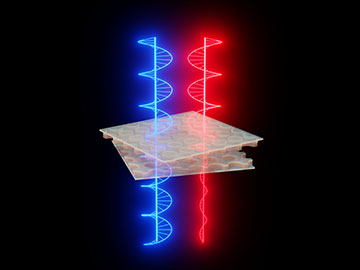
Researchers have shown how to manipulate the chirality of light by using MEMS technology to twist one photonic crystal relative to another. The blue and red beams show left- and right-handed circularly polarized beams, respectively. [Image: Mazur group at Harvard SEAS]
Scientists in the United States have combined photonic crystals with microelectromechanical systems (MEMS) technology to fabricate an on-chip structure able to tune the chirality of light without needing any change of optical components (Optica, doi: 10.1364/OPTICA.578880). The researchers reckon that the compact all-dielectric device could find application in chiral sensing, polarization control and optical communications.
Intrinsic chirality
Chirality is a property of certain molecules and other objects whose mirror images, like left and right hands, cannot be superimposed on one another. It is also a characteristic of light, which manifests as left- and right-handed circularly polarized waves.
Researchers have previously built nanometer-scale structures to engineer light with a given chirality but have relied on specific experimental configurations for the task. Instead, the latest work involves chirality that is intrinsic to the structure in question, which enables greater versatility—such as being able to carry out measurements with light normally incident on a sample.
Eric Mazur, Fan Du and coworkers at Harvard University, working with colleagues at the University of California, Berkeley and Stanford University, have demonstrated intrinsic chirality using a pair of two-dimensional photonic crystals. Each photonic crystal consists of a square lattice of roughly micrometer-sized holes carved into a slab of silicon nitride about 400-nm thick. Individually, the patterned slabs impart no change in chirality on a passing laser beam. And the same is true when the two are placed on top of one another so that their holes line up.
The trick was instead to position one of the slabs at an angle to the other. The researchers did this by integrating one of them inside a MEMS and suspending the other in a fixed position above. They built the tiny structure on a silicon substrate and then were able to rotate the lower photonic crystal as well as change the distance between the two.
Initially keeping the two photonic crystals at a fixed, finite “twist” angle and separation, Mazur and colleagues exposed the device to left- and right-handed near-infrared laser light. They varied the precise frequency of the light to observe the polarization-dependent transmission known as circular dichroism. The fact that they observed maximum transmission at different frequencies in the two types of light, they say, “demonstrates the chiral nature” of the nanofabricated system.
The simulations predicted that the system should exhibit perfect circular dichroism, meaning that at specific frequencies it ought to transmit only one handedness of light.
A tuneable device
But what really sets the system apart, they claim, is its tunability. Via the MEMS, a user can vary the twist angle from 9° to 13° and, independently, the layer separation from 360 nm to 1500 nm. Those changes, they explain, modulate the system’s geometric chirality that in turn dictates its optical chirality.
When varying the twist angle while keeping the separation constant and vice versa, the researchers found significant variations in transmission. They say that these variations proved a close match to theoretical simulations that they carried out by calculating the coupled light waves between the two photonic crystals. In particular, they observed that, as expected, chirality disappears when the gap between the two layers becomes large enough that they begin to act independently of one another.
The simulations predicted that the system should exhibit perfect circular dichroism, meaning that at specific frequencies it ought to transmit only one handedness of light. Instead, the maximum circular dichroism was 85% for left-handed light and just 64% for the right-handed variety. The researchers attribute the shortfalls to measurement noise and experimental imperfections such as finite beam-spot size and less than perfect normal incidence.
Ranging applications
Despite these shortcomings, Mazur and colleagues argue that the technology could be used in a range of applications—given not only its tunability, compactness and ease of use but also its compatibility with CMOS fabrication. In particular, they say, it would be well suited to programmable chiral sensing or imaging within a certain frequency range, especially the near-infrared. The chip’s tunability, they explain, would enable optimized chiral contrast for different targets at different wavelengths.
What’s more, the researchers say, the device could be an excellent source of circularly polarized light. They explain that by suitable operation of the MEMS, it is possible to convert linearly polarized light at the input into both right- and left-circularly polarized light at the output—the purity of that output, they say, is guaranteed by the ability to continually vary the twist angle and interlayer separation.
Other potential applications, the team adds, include optical communications, advanced imaging and, via the integration of gain materials, spin-selective lasing.
