

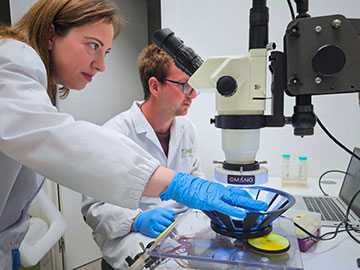
Institute for Bioengineering of Catalonia researchers Rosalba Sortino (left) and Joaquin Martinez Tambella. [Image: IBEC]
Researchers in Spain have shown that light-sensitive molecules that mimic the function of photoreceptor cells can restore the sight of blind mice (J. Am. Chem. Soc., doi: 10.1021/jacs.5c18611). They believe that the new family of photo-activated compounds, called prosthe6, could enable the development of noninvasive drug therapies to recover the vision of patients with degenerative retinal disorders.
Treating disease-born blindness
Many of the most common blinding diseases, such as age-related macular degeneration, result from the progressive breakdown of photoreceptor cells in the retina. Reversing this loss of sensitivity currently relies on the use of electronic retinal implants, which are unsuitable for most patients because they are expensive, require invasive surgery and demand extensive training to achieve even modest results.
Light-responsive drugs offer a more accessible alternative, with preliminary results from a clinical trial suggesting that controlling cellular processes with photoswitchable compounds could provide a safe and effective therapeutic strategy. In this new work, the researchers adapted this approach to achieve a more targeted drug action. They designed light-sensitive molecules that activate protein receptors that are only found in a specific type of retinal cell.
Replacing lost photoreceptors
In healthy vision, these ON bipolar cells transfer optical information from the photoreceptors to the visual circuit. The prosthe6 molecules take the place of the lost photoreceptors: Light entering the eye causes them to change their shape, which in turn triggers a response from the ON bipolar cells that closely resembles a natural visual signal. “Our goal was to restore vision using a molecular mechanism that is as close as possible to how the healthy retina works,” says study author Rosalba Sortino of the Institute for Bioengineering of Catalonia (IBEC).
The researchers tested their approach by administering a solution containing the molecules to zebrafish larvae, which focus their gaze using the same rapid eye movements as humans. When a droplet of the solution was applied to blind larvae, this optokinetic response was revived with an efficacy of up to 75%.
The prosthe6 compounds were also found to restore light-driven behavior in mice that were completely blind, with the animals recovering their natural preference for dark environments just a few hours after being treated with eye drops or an injection into the eye. The restored behavior was observed under normal lighting conditions, with none of the mice showing signs of pain, distress or changes to the shape or structure of the eye.
The researchers are now evaluating the safety and formulation of the compounds for extended use, and through a spin-off company they are preparing to translate the technology into clinical trials. “Turning this into a therapy is a long and laborious process,” says team leader Pau Gorostiza. “But the results show that there is a realistic possibility of restoring high-quality vision with noninvasive drugs and with a mechanism that is independent of the specific retinal disorder.”
