

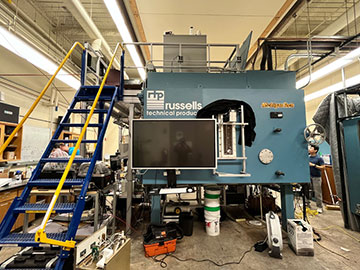
A single-photon lidar that can resolve cloud structures at the centimeter scale was tested using an experimental chamber that generates clouds under carefully controlled conditions. [Image: Michigan Technological University]
Researchers in the United States have demonstrated a laser-based remote-sensing system that can observe cloud structures on the centimeter scale, some 100 to 1,000 times more detailed than existing atmospheric lidars (Proc. Natl. Acad. Sci., doi: 10.1073/pnas.2505421122). When used to view clouds generated in a laboratory chamber, the fine structural features revealed by the lidar system could be related to measurements of microscopic cloud properties that affect the brightness of the cloud and its likelihood of producing rain.
Capturing a cloud’s microstructure
The results show how cloud droplets near the tops of clouds differ from those within the interior. Such small-scale variations are crucial for understanding the evolution of clouds and their influence on the Earth’s climate, but they are not captured by atmospheric measurements or numerical models. “This is the first time we’ve been able to see these cloud-top microstructures directly and noninvasively,” said Fan Yang of Brookhaven National Laboratory, the lead author of the study.
The lidar system developed by the team exploits time-correlated single-photon counting, a technique that measures the arrival time of backscattered photons when ultrashort laser pulses are fired into the cloud. To enhance the resolution, the researchers designed and built a dedicated fiber laser that emits pulses of 30 ps at a high repetition rate, which they also used to generate a precise reference signal for the timing electronics.
When combined with a single-photon detector, the lidar system achieves a timing resolution of 80 ps, equivalent to a range resolution of 1.2 cm. The system is also configured to detect only the first photon to arrive at the detector, an approach that allows small spatial structures to be recovered in environments with low photon counts and high background noise. The profile of these first-arriving photons can then be related to cloud properties such as the number of droplets and their size distribution.
When combined with a single-photon detector, the lidar system achieves a timing resolution of 80 ps, equivalent to a range resolution of 1.2 cm.
Toward improved models
The team tested its tool using clouds generated under specific temperature and humidity conditions within an experimental chamber at Michigan Technological University. The measurements showed that the top 10 cm of the cloud contained many fewer droplets than the bulk, caused mainly by water evaporating from the top surface of the cloud. The next 10 cm also contained fewer droplets than the interior, this time resulting from larger droplets falling into the cloud and leaving only the smaller ones behind.
Understanding the detailed physical mechanisms at the tops of clouds could help to improve atmospheric models, which typically neglect or simplify such small-scale variations. “An inaccurate representation of cloud-top physics can introduce substantial uncertainty into model predictions of how clouds reflect sunlight and trigger rainfall,” said Fang. Controlled experiments in a cloud chamber will also be important for calibrating the measurements taken by airborne single-photon instruments, such as the T2 lidar built by Fang’s Brookhaven team.
