

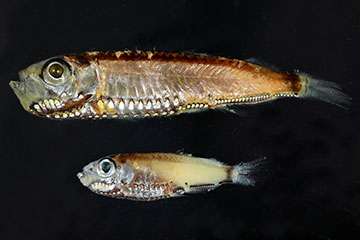
These pearlside fish are one of only a few creatures to have developed hybrid photoreceptors in their retinas [Image: Wen-Sung Chung]
An international team of researchers has investigated a unique visual strategy that enables deep-sea fish to see in gloomy waters (Sci. Adv., doi: 10.1126/sciadv.adx2596). The biological adaptation, seen in the retina of fish that live at depths of up to 200 m, could offer new insights for treating common eye conditions and for designing cameras and goggles that operate efficiently in low-light conditions.
A hybrid photoreceptor
The visual system of all vertebrate species relies on photoreceptors found on the back of the retina. The rods are optimized to see in the dark, while the cones provide detail and color in the bright light of day. However, a small number of creatures, including pearlside fish and certain types of lizards, have been found to possess a hybrid photoreceptor that improves their vision in gloomy or twilight conditions.
These rod-like cones combine the molecular machinery of cones with the shape and form of rods. “This hybrid cell has the best bits of both the bright-light and dark-light systems to create something that's really efficient for twilight vision,” said Fabio Cortesi of the University of Queensland, Australia, who led the study.
All of the fish larvae were found to possess the hybrid rod-like cones, suggesting that they form very early in the larvae’s development.
Rod-like cone development
The researchers were keen to understand how these photoreceptors develop in newly hatched larvae, which feed and grow in the half-light closer to the surface. They examined the retinas of larvae caught at depths between 20 and 200 m in the Red Sea, focusing on three deep-water species that follow slightly different lifecycles.
All of the fish larvae were found to possess the hybrid rod-like cones, suggesting that they form very early in the larvae’s development. The pearlside fish, which continue to live at similar depths throughout their lifetime, retain the rod-like cones into adulthood. The other two species—the skinny lanternfish and a rare type of light fish—descend into deeper waters when fully grown, and in this case the hybrid photoreceptors morph into true rods that enable the fish to see in the dark.
The researchers suggest that the early appearance of the rod-like cones indicates that have they have evolved as a distinct type of photoreceptor, rather than as a combination of rods and cones. The presence of rod-like cones in the larvae could also ease the molecular processes that enable the transition to pure rods in the adult fish.
As well as providing new insights into life within the deep sea, the researchers believe that their findings could lead to practical applications. “Creating sensors based on this unique cell structure could lead to more efficient cameras or goggles for low-light situations,” said Cortesi. “Learning how these fish build this type of visual cell in the high-pressure environment of the deep ocean could also unlock new biological pathways that are relevant to human eye conditions such as glaucoma.”
