

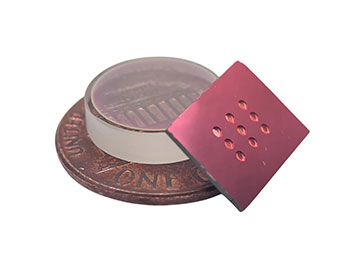
A fabricated micromirror array next to a penny, compared with a half-inch diameter commercial mirror. [Image: Brandon Grinkemeyer / Lukin lab at Harvard]
The rise of quantum optical applications has led to greater demand for smaller optical cavities with high performance, particularly in the near-infrared (NIR) and visible ranges. However, creating such devices is challenging since the traditional fabrication approach based on polished mirrors creates large cavities that are not easily scalable. Also, compared with telecom wavelengths, shorter wavelengths impose stricter requirements on the surface quality to achieve high performance.
Now, researchers from Harvard University, USA, report a simple, robust and scalable method for fabricating state-of-the-art NIR microcavities with ultra-smooth surfaces (Optica, doi: 10.1364/OPTICA.582994). The resulting devices could play a role in next-generation quantum computers, quantum networks, integrated lasers, environmental sensing equipment and other technologies.
Buckled mirrors
Originally, the researchers aimed to build quantum networks out of ultracold single atoms, which required optical cavities with extremely smooth mirrors that would strongly couple atoms to photons. Many current microfabrication methods create cavities that are limited by lower performance and larger size than what is needed for the most demanding quantum applications.
“We needed these high-quality photonic interfaces to create efficient ways to have single photons interact with single atoms, allowing for fast, high-fidelity quantum networking,” said study author Brandon Grinkemeyer in a press release accompanying the research.
The novel approach uses buckled dielectric membrane mirrors to create a combination of high finesse, standard silicon fabrication, small mode volume and small radius of curvature. A precisely engineered stack of transparent oxide layers, when released from a silicon wafer, naturally buckles into a perfectly curved shape due to built-in compressive strain in the dielectric coating.
A record finesse
The researchers achieved a record finesse of 0.9 million at 780 nm for microcavities, meaning light can reflect nearly a million times inside the cavity before scattering. The fabrication is flexible and scalable, and it can be performed in a common cleanroom environment with high tolerance to errors.
“In microfabrication, we are sometimes confined by the thought that surface roughness is defined by the etch or the mask, and we try very hard to optimize them,” said study author Sophie Ding, a former Harvard graduate student. “But when we are using the properties of the materials, we can do a lot less of that and have more robust results.”
