

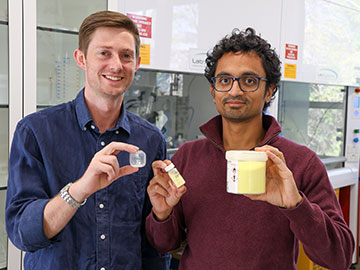
Researchers Samuel J. Tonkin (left) and Harshal D. Patel with the inexpensive organic raw materials used to make the infrared thermal imaging lens in the Chalker Laboratory at Flinders University, Australia. [Image: Courtesy of Flinders University]
Thermal imaging cameras are finding more consumer-oriented applications than ever before. Such cameras, however, rely on expensive, impossible-to-repair lenses made of semiconductors or chalcogenide glass.
Now, researchers at an Australian university have devised a method for synthesizing a sulfur-based organic polymer to make inexpensive thermal-imaging lenses (Nat. Commun., doi: 10.1038/s41467-026-68889-0). The sulfur in the new lens material is a byproduct of petroleum refining, so it’s readily available to manufacturers. And the lens polymer can be molded like other plastic materials, instead of going through a painstaking lens-grinding process.
A difficult process
Other research teams had postulated the existence of this sulfur-based polymer, but conventional methods of creating the material didn’t work because of side reactions that generated a mixture of many unwanted compounds, says researcher Justin M. Chalker, Flinders University. The mixed-in byproducts made the compound absorb too much infrared light to be useful as a lens. According to Chalker and colleagues, many other sulfur-based polymers have less long-wavelength infrared (LWIR, 8-15 μm) transmittance than is required for many potential lens applications.
To create “polymer 1,” as the team dubbed the new material, the researchers synthesized precursor monomers that are soluble in molten sulfur and then used those monomers to create the final polymer, which contains 81% sulfur by mass. “The sulfur gives the polymer high refractive index (important for focusing power) and transparency to the infrared light that passes through the lens,” Chalker says. “The organic part of the polymer is critical for thermal stability and shape persistence. If you just use sulfur, the polymer is not stable.”
Proof of concept and next steps
As a proof of concept, the Flinders team cast-molded and polished lenses out of the new material and measured their transmittance of light in the mid-wavelength infrared (MWIR, 3-8 μm) and LWIR bands. “We validated the theoretical prediction that it [the material] should be useful in thermal imaging and overcame the previous challenges in making this polymer,” Chalker says. The researchers also added the lenses to a small prototype camera and measured its still-photo and video imaging performance at 100°C, 40°C and ambient (room) temperature.
For commercial progress, the team and its prospective industry partners need to devise larger-scale processes for polymer production and lens molding, Chalker says. The researchers will refine the lens material for improved thermal imaging, with potential applications such as defense, security cameras, self-driving automobiles and firefighting.
