

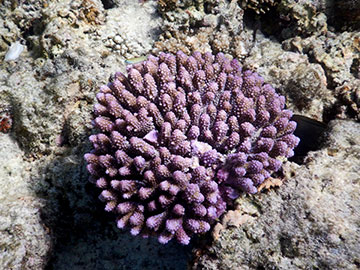
Unlike typical opsins, the anthozoan-specific opsin II group in reef-building corals use chloride ions instead of amino acids as counterions. [Image: Federica Grassi/ Getty Images]
Researchers in Japan and Switzerland have reportedly found the chemical basis for the light-sensing abilities of these marine invertebrates (eLife, doi:10.7554/eLife.105451 ). The proteins that corals use to detect light rely on chloride ions from their environment to switch between visible- and ultraviolet-light vision. This pH-dependent sight provides clues to the corals’ symbiotic relationship with photosynthesizing algae and the wider ecosystem.
The proteins of vision
The eyes of animals contain light-sensitive molecules called opsins, which bind to chromophore molecules to create pigments. The pigments convert incoming photons to electrochemical signals that animals perceive as vision. Most animals use retinal—a substance related to vitamin A—as the chromophore that triggers the sensory cascade. Isolated from opsins, retinal’s absorption peaks in the UV region of the spectrum. However, the peak shifts into the visible range when the retinal binds to the opsin. This process results in a slight positive charge, requiring the presence of a negatively charged “counterion” to keep everything stable.
Reef-building corals, part of the subphylum Anthozoa, have different opsins called anthozoan-specific opsins, or ASOs. These ASOs don’t contain the amino acids that act as counterions in the opsins of most other animals.
Adjusting light sensitivity
Symbiotic photosynthetic algae provide corals with nutrients—and change the pH inside coral cells.
Scientists based at Osaka Metropolitan University, Japan, extracted opsins from corals of the species Acropora tenuis and measured the absorption spectra of their component amino acids. The team exposed the amino acids to various halide solutions and then solutions with varying levels of sodium chloride, which is of course abundant in sea water.
A glutamic acid sequence in a specific location on the opsin protein facilitates the use of negative chloride ions as the necessary counterions, according to the research team. “We found that chloride ions stabilize the Schiff base [a type of bond between chromophore and opsin] more weakly than amino acids do, so the opsin can reversibly switch between visible-light sensitivity and UV sensitivity depending on the pH,” first author Yusuke Sakai said in a statement. Under lower-pH conditions, fewer protons lead to the absorption of longer wavelengths of light. When the pH is high, protons leave the Schiff bases, making them more sensitive to UV light.
Symbiotic photosynthetic algae provide corals with nutrients—and change the pH inside coral cells. Thus, the researchers suggest, corals adjust their light sensitivity based on the activity levels of the algae that they host.
The team hopes that its discovery could inspire new biotechnology, in addition to offering a better understanding of coral biology. “The ASO-II opsin of Acropora tenuis was shown to regulate calcium ions in a light-dependent way, hinting at potential applications as an optogenetic tool whose wavelength sensitivity changes with pH,” said Mitsumasa Koyanagi.
