

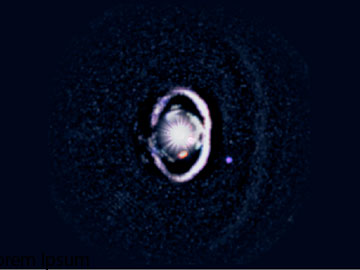
An optical image of the WISPIT-2 system reveals a protoplanet (purple dot) within a gap in a multi-ringed disk of gas and dust [Image: Laird Close, University of Arizona]
Two parallel studies have captured the first pictures of a protoplanet as it forms within a disk-shaped structure containing multiple rings of dust and gas (Astrophys. J., doi: 10.3847/2041-8213/adf7a5 and 10.3847/2041-8213/adf721). With images and data obtained at both visible and infrared wavelengths, the confirmed sighting offers a model system for astronomers to study the mechanisms that enable planets to form and grow.
Searching in the gaps
Many of the planet-forming disks that surround young stars have been observed to display multiple rings with gaps between them, suggesting that the material is being subsumed into a growing planet. However, only three of these protoplanets have been discovered to date, and none of these have been seen within a gap in the ring structure.
In this case, the astronomers turned their attention to WISPIT-2, a young star with a mass similar to our sun. Suspecting that the disk orbiting this star might harbor one or more emerging planets, they observed the system at visible wavelengths using the Magellan Telescopes and in the near-infrared using the Very Large Telescope, both of which are located in Chile’s Atacama Desert.
Detecting the faint optical signal from the protoplanet required the development of an advanced system for adaptive optics, called MagAO-X. While adaptive optics is widely used to improve the quality of telescope images by compensating for the effects of atmospheric turbulence, this system was specifically designed to detect the light generated by hydrogen gas as it falls onto the surface of a protoplanet.
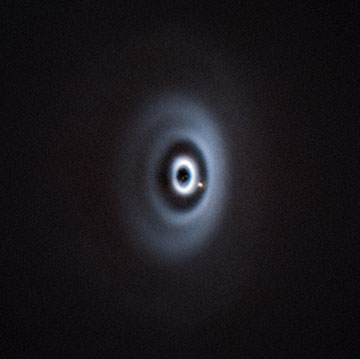
An image taken of WISPIT-2 in infrared wavelengths reveals the detailed structure of the protoplanetary disk [Image: ESO/R F van Capelleveen et al.]
“As planets form and grow, they suck in hydrogen gas from their surroundings,” explains Laird Close of the University of Arizona, USA, who led the team that built the MagAO-X system. “When the gas hits the surface of the protoplanet it creates extremely hot plasma that in turn emits a particular light signature.”
Found protoplanets
When WISPIT-2 was viewed using this so-called H⍺ light, a small purple dot could be seen between two outer rings of the protoplanetary disk. Further analysis of the light emission indicates that this planet, dubbed WISPIT-2b, is a gas giant five times more massive than Jupiter that is still accreting material onto itself. Another point-like object can be seen between the star and the inner edge of the disk, which could be another young planet or a large clump of dust.
The infrared images offer a clearer view of the protoplanetary disk. It is composed of four rings, with WISPIT-2b carving out a clear gap between rings two and three that is consistent with the protoplanet's estimated mass. A cavity between the star and the disk can also be seen that could have been created by the inner object observed in the optical images.
The discovery provides an ideal system for astronomers to better understand the mechanisms that enable a protoplanet to accrete material from its surrounding disk. Further observations will be needed to uncover more details about WISPIT-2b and its inner companion, which could offer new insights into the early formation of our own solar system.
