

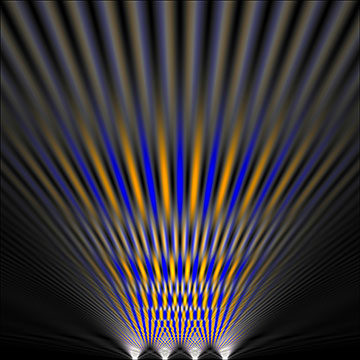
Detection of time-bin superpositions with the temporal Talbot carpet. [Image: Maciej Ogrodnik, University of Warsaw]
An optical effect discovered nearly two centuries ago could play a role in modern-day quantum cryptography.
Researchers based in Poland have tested a new method for time-phase quantum key distribution (QKD) encoding in two and four dimensions (Opt. Quantum, doi:10.1364/OPTICAQ.560373). Inspired by the so-called Talbot effect—but deploying it in time rather than space—the scientists used simple components, including a single-photon detector, that could someday fit on a photonic chip.
The Talbot effect
In 1836, photographer Henry Fox Talbot discovered that when plane waves of light pass through a periodic diffraction grating, the light repeats the image of the grating at certain distances from the device. Smaller sub-images appear at fractions of that distance, creating a fractal “Talbot carpet” of ever-shrinking pictures of the grating.
More recently, by substituting trains of light pulses for the plane wave, scientists have been experimenting with the Talbot effect in time rather than space. A pulse train propagating through a dispersive medium, such as an optical fiber, creates time-bin superpositions of equally spaced pulses.
Application to quantum cryptography
Most QKD systems employ qubits, which are superpositions of two-dimensional states and which carry one bit of information. To make photons carry more information, scientists have been experimenting with “qudits,” d-dimensional quantum states where d equals an integer. But proposed QKD schemes with higher dimensions have more complexity than qubit-based methods.
The experiments used the time-tested BB84 QKD protocol for secure transmission and showed that the four-dimensional qudit (or “ququart”) outperforms the qubit despite a slightly higher quantum bit error rate.
Last year, Adam Widomski, Maciej Ogrodnik and Michał Karpiński of the University of Warsaw demonstrated how a single time-resolved photon detector can pick up multidimensional superpositions using the temporal Talbot effect (Optica, doi:10.1364/OPTICA.503095). In their current experiments, the trio and their colleagues set up a sender (“Alice”) and receiver (“Bob”) in the laboratory and sent signals either through a fiber spool or over a 13-km link in the university’s dark fiber network in downtown Warsaw.
The light powering “Alice” came from a continuous-wave laser operating at the usual telecommunications wavelength of 1560 nm, with pulses generated by a Mach-Zehnder modulator and a phase modulator. Over at the “Bob” end, superconducting single-photon detectors provided time-domain measurements. A dispersion compensating module provided group delay dispersion for the temporal Talbot effect.
The experiments used the time-tested BB84 QKD protocol for secure transmission and showed that the four-dimensional qudit (or “ququart”) outperforms the qubit despite a slightly higher quantum bit error rate. Additional researchers from Italy and Germany tested the security of the Warsaw QKD setup.
“The advantage of our method is its high efficiency, as all photon-detection events are useful. The drawback is relatively high measurement error rates,” said Widomski. “However, these do not prevent QKD ... Furthermore, we do not need to rebuild the setup for different dimensions of superpositions—we can detect 2D and 4D superpositions without changing hardware or stabilizing the receiver. This is a huge advantage compared [with] earlier methods.”
