

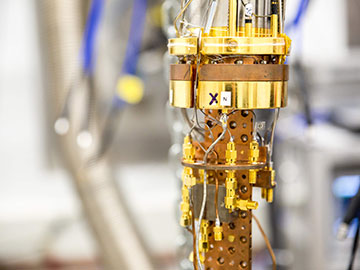
A time crystal formed on top of a superfluid in ultracold conditions. [Image: Mikko Raskinen/Aalto University]
A time crystal is a unique form of matter that exhibits a repeating structure in time, similar to how atoms in a conventional crystal repeat in space. Time crystals, first experimentally realized in 2016, have been created in a range of physical systems and coupled to other time crystals, but always in isolation from their environment.
Now, researchers at Aalto University in Finland say they have, for the first time, connected a time crystal to an external physical system (Nat. Commun., doi: 10.1038/s41467-025-64673-8). The setup—a continuous time crystal coupled to a macroscopic mechanical oscillator—could be used as a highly sensitive probe for basic research, such as searching for dark matter.
A key component
Initially, Jere Mäkinen and his colleagues planned to study fluid dynamics—namely, surface waves in superfluid—by using magnon Bose-Einstein condensate as a probe. Mäkinen’s research focuses on novel topological structures and their dynamics in topological superfluids at ultra-cold temperatures.
“When I dug into the analysis, however, it became apparent that we did not quite understand the interaction between the surface waves and the time crystal in detail,” said study author Mäkinen. “It was clear that we had to study the interaction further.”
In the end, they created a time crystal formed of magnetic quasiparticles of superfluid helium-3, or magnons, and had it successfully interact with a nearby liquid surface. The time crystal frequency was modulated by the motion of the free surface, providing a key component of a cavity optomechanical system.
The team’s efforts have led to a new methodology the researchers call “time-crystal optomechanics,” which combines the inherent coherence of time crystals with the sensitivity of optomechanical systems.
“The coupling between the surface waves and the time crystal is mediated by the internal structure of the superfluid—in turn affected by, for example, the surface shape and orientation, the number of quasiparticles in the time crystal, and the superflow associated with the surface waves,” Mäkinen explained.
Time-crystal optomechanics
The team’s efforts have led to a new methodology the researchers call “time-crystal optomechanics,” which combines the inherent coherence of time crystals with the sensitivity of optomechanical systems. The overall concept of tuning the period of a continuous time crystal to an external degree of freedom should open new avenues for research on time crystals.
The next steps for the researchers involve miniaturizing the mechanical mode—for example, by using nanofabricated mechanical resonators. This change alone would result in orders of magnitude of lower mass, higher mechanical frequency and lower losses, according to Mäkinen, all of which are crucial for reaching the quantum limit.
“After some optimization, mostly in terms of choosing a better-suited mechanical resonator, one could be able to push the system to the quantum limit, at which point applications related to quantum information [such as qubit and quantum memory] become possibilities,” he said. “We also note that, while our result is a conceptual one and demonstrates novel phenomena, similar physics should be in principle accessible at room temperature in some other systems.”
