

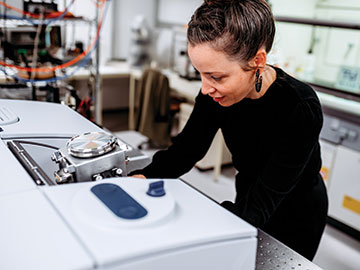
Josiane Lafleur. [Image: Invisible-Light Labs]
The July/August 2025 issue of Optics & Photonics News featured the magazine’s biennial “10 Entrepreneurs to Watch.” Here, we speak with Josiane Lafleur, cofounder and CEO of Invisible-Light Labs, an Austrian startup that has developed a groundbreaking nanomechanical infrared sensing technology that could transform environmental monitoring, nanoparticle characterization and biopharmaceutical research.
Tell me about your journey into entrepreneurship. What inspired you to start the company?
Entrepreneur isn’t a word I’d have used to describe myself. I’m a scientist. But I believed so strongly in our technology that I wanted it to exist in the real world, not just in a scientific journal. I wanted it to be accessible—to be useful.
I did my Ph.D. in chemistry at McGill in Montreal, Canada, then a postdoc at DTU Nanotech in Denmark, working on micro- and nanoscale analytical tools. That’s where I met my cofounder, now also my husband. His work is in nanomechanics. Later, I became an assistant professor at the University of Copenhagen, in the pharmacy department, while he was developing these incredibly sensitive tools at the Technical University of Denmark. I was already sending my students to use his equipment.
Eventually, we moved to Vienna, Austria. I left my tenure-track role and was preparing to restart at TU Vienna—but after a long maternity leave and major life changes, the idea of rebuilding my academic career from scratch felt overwhelming. One evening over dinner, we were talking about his technology, and I said, “If I’m going to start a lab again, I want that tool.” And then it clicked. Why not build it? Why not make it available?
That’s how Invisible-Light Labs started. It wasn’t a strategic decision. It was more like: “This should exist—so let’s make it happen.”
What was the original technology like?
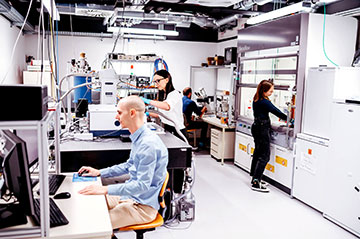
Some of the team in the lab. [Image: Invisible-Light Labs]
Extremely cool—and completely unusable by most labs. It used expensive quantum cascade lasers and complex electronics. The detection was based on a new nanomechanical concept that could measure infrared light with exceptional sensitivity. But it wasn’t practical for a lab technician or a non-specialist chemist.
So we reimagined it as an add-on for existing FTIR spectrometers—an instrument found in labs around the world. FTIR is standard in chemistry education and research, but it’s losing ground to techniques like mass spectrometry because it’s not very sensitive. We wanted to change that.
We rebuilt everything: electronics, software, hardware. It had to be intuitive, robust, and plug-and-play. It took about five years, and we were lucky to get a European Innovation Council Transition Grant in 2022. That let us go from a team of two to ten—engineers, software developers, embedded systems experts. We submitted patents on the electronics and other aspects of the technology and started preparing for launch.
What were some of the breakthrough moments?
One big moment was when my cofounder went to present the prototype at a Bruker Optics user meeting. We’d taken a huge risk—built our system to be compatible with Bruker FTIR instruments without a formal partnership in place.
At first, we weren’t sure how it had landed. But the next day, people were asking questions, proposing collaborations… the president of Bruker Optics wanting to talk. It was the first time people were truly excited about the product. That conversation eventually turned into a formal collaboration and Bruker is now distributing a co-branded version of our system.
That was huge. For the first time, we felt like we’d created something that people didn’t just understand—they wanted it.
What has been the hardest part of building the company?
The mindset shift. As a researcher, you’re driven by curiosity. You want to understand everything, follow every question. But when you're running a company, especially with grant funding, you need to deliver. You have to focus on milestones, on what’s sellable. I found myself saying things like, “That’s interesting, but can we commercialize it?” This felt very unnatural at first.
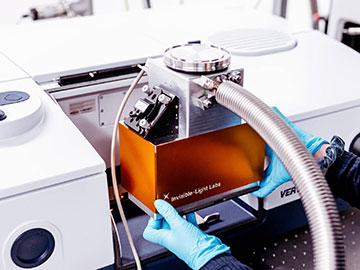
EMILIE nanomechanical infrared analyzer. [Image: Invisible-Light Labs]
I also went back and did an MBA—not to become a businessperson, but to learn what I didn’t know. I needed to understand finances, markets, contracts. My first investor decks were full of equations. I had to learn how to translate technology into value, how to speak the language of investors and regulators.
It was tough because we didn’t start with a problem and build a solution. We had a unique piece of technology, and we wanted to share it with the world. That’s a harder sell.
What real-world problems does it solve?
At its core, it’s a tool that can detect and characterize very small particles with high sensitivity—ultrafine pollutants, nanoplastics, nanoparticles in drug formulations, and more. These things are all around us, and most of them go unregulated simply because we don’t have the tools to study them properly.
For example, airborne particles smaller than 2.5 micrometers can have serious health impacts because they reach deep into the lungs, but we’ve barely regulated them because their chemical composition has been hard to measure. Our tool can do that and our hope is that it will support stronger environmental policies in the future.
It’s the same with nanomedicine. Drug delivery platforms using nanoparticles and other nanomedicines are becoming more common, but characterizing them is a challenge. Our system helps researchers get that data more easily.
What’s the market path forward?
Deep tech takes time. We're just entering the market now. The first step is academic validation—scientific papers, collaborations, getting instruments into real labs. We’ve started installations across Europe, including at EPFL and several Austrian research groups.
We expect regulations to take time, especially in areas like air quality. The new EU Air Quality directive should be revised every five years, so we’re aiming to build enough evidence in that window to support new monitoring standards. Meanwhile, we’re focused on building credibility and usage in academia and pharma.
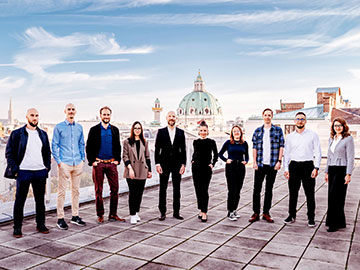
The Invisible-Light Labs team. [Image: Invisible-Light Labs]
And what kind of culture are you trying to build at Invisible-Light Labs?
It’s something we think about a lot. When you start a company, especially from academia, you don’t always consider leadership style or organizational structure and culture. But it matters deeply.
We don’t have rigid roles. Everyone wears multiple hats. People working on assembly also work on product development, testing, design, and even customer visits. We try to give people real ownership—space to contribute and make decisions. That’s what motivates smart people.
We also prioritize psychological safety. When you’re doing something this new, there are going to be problems. People need to feel safe flagging them, suggesting changes, speaking up. That’s how innovation happens.
Do you have a formal innovation process?
Not a formal one, no. Innovation is built into our day-to-day work. We’re a small team, and everyone is involved in product development. We work closely with our customers and they constantly bring us new use cases and sample types. That feedback loop is essential as it sparks most of our R&D.
What’s next for the company?
We’ve just achieved CE compliance and are entering broader commercialization. The partnership with Bruker will help us reach labs across the globe. At the same time, we’re developing a standalone system using quantum cascade lasers. It is a more advanced platform based on the same detection principle. Every milestone opens up new challenges, new products, new opportunities. We’re still learning every day.
And for you personally?
I’m proud of what we’ve built. It wasn’t a dream from the start—I just saw something that needed to exist. I’m glad we took that leap. Now I want to keep building, contributing, and hopefully inspiring other scientists to bring their work into the world.
