


Karolina Orłowska. [Image: Gekko Photonics]
The July/August 2025 issue of Optics & Photonics News features the magazine’s biennial feature spotlight 10 Entrepreneurs to Watch. Here, we speak with Karolina Orłowska, cofounder and chief science officer of Gekko Photonics, a Polish startup developing a Raman-based platform that merges advanced optical instrumentation with smart algorithms. The company aims to simplify chemical diagnostics, improve real-time monitoring and bridge the gap between research and industry.
Tell me about your journey into entrepreneurship. What inspired you to start your company?
That’s always a hard question. I didn’t start with the goal of building a company. When I first began studying physics at Wrocław University of Science and Technology, Poland, I was mostly looking for interesting challenges. It wasn’t about business or entrepreneurship—it was about discovery.
I went on to complete my Ph.D. in light force metrology. After that, I reconnected with some colleagues who were working on Raman spectroscopy for biological and medical investigations. I had previous experience with Raman, and the project sounded fascinating—complex, interdisciplinary, full of unknowns. I was drawn to that.
The project evolved and at some point it made sense to formalize it as a company. But for me, the key factor wasn’t the technology—it was the people. A great group, very open-minded, skilled in different areas. And when you're working on something as complicated as this, you need that. Building a company around an idea is hard, but building one around people you trust? That made it easier.
What problem does Gekko Photonics solve, and what is the core of your technology?
It’s been a long journey. We started by working on biomedical applications (e.g. glucose monitoring, sweat analysis) using Raman and surface-enhanced Raman spectroscopy (SERS). We were trying to read biological markers non-invasively, which is incredibly powerful, but the development cycles are long.
We needed a path that allowed us to grow sustainably. That’s when we shifted toward the chemical industry. We realized that quality control, especially in manufacturing environments, was a weak point. Even in Europe, in 2025, it’s common to see chemical processes where quality control means taking a sample, sending it to a lab, and waiting—sometimes for days—to get results. That’s not compatible with modern manufacturing expectations.
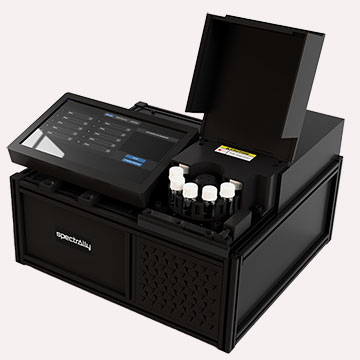
The company's "Spectrally" Raman spectroscopy-based platform. [Image: Gekko Photonics]
Our technology uses optical sensors, especially Raman spectroscopy, to provide immediate, real-time data from within the process itself. Instead of interpreting complicated spectra manually, we provide users with clean outputs: a concentration value, a reaction rate, a mixing index. It’s about turning complex physical data into something clear and usable.
So you’ve developed both the instruments and the data analytics?
Yes, we design everything—from the optical paths and probe systems to the embedded software and AI-based algorithms. We built the instruments lens by lens, prism by prism. Nothing is off-the-shelf. We wanted tools optimized for specific industrial needs.
Then we built the software to go with it. And that’s really where a lot of our innovation lies—turning those beautiful but difficult Raman spectra into numbers. The client doesn’t need to understand the physics. They get what they need: the concentration of a target substance, the completeness of a reaction, the homogeneity of a mixture.
And the goal is to make all this available online—in the process?
Exactly. We created a probe that can be placed directly inside a mixing chamber or reactor. The measurement happens inside the process, not in a lab. That means real-time feedback and the possibility to adjust immediately.
And when you combine multiple probes across a production system, you get even more insight. You can track reaction speed, identify inefficiencies, and predict end points. It opens the door to truly intelligent manufacturing—what Industry 4.0 promises but hasn’t always delivered in chemistry.
That’s a powerful value proposition. What were the major challenges?
One was communication. Our team is multidisciplinary—optics, electronics, mechanics, chemistry, software—and each of us speaks a different “language.” Explaining Raman spectroscopy to an embedded systems engineer or explaining data structures to a physicist… It took time.
[Image: Gekko Photonics]
But it was fun. We’re a close team, and really enjoy working together. Sometimes we’d stay late and run silly experiments just for fun. That camaraderie helped us through tough times. I think joy is underrated in startups—it keeps you going when the pressure is high.
Another challenge was understanding the language of our customers. We’re physicists, but we don’t sell to physicists. Our clients are often chemists or industrial engineers, and they think differently. Things that were obvious to us weren’t obvious to them—and the other way around. So we had to translate, not just the technical data, but our whole way of talking about it. That was one of the most important things we learned.
How is your approach unique in the optics and photonics space?
Raman is not new; it’s been around for decades. But what’s new is how we use it. Our system is not just an instrument. It’s a platform that combines multiple sensing modalities, defines tailored measurement protocols, and translates complex spectra into actionable metrics.
We often say we’re “translating the Raman language.” Instead of giving users a plot and asking them to interpret it, we give them a number: the alcohol content, the dye concentration, the reaction progress. That shift—from abstract spectra to clear outputs—is what makes our technology truly usable outside of optics labs.
Was there a particular moment when you realized the company was going to succeed?
Yes, there was one moment I’ll never forget. It was in 2022. We were still focused on biomedical applications, and we had been struggling. The product worked—but not reliably enough. And we were almost out of funding.
An investor visited us, and we showed her our plans for expanding into the chemical industry. She was so excited. I remember she said, “This is brilliant.” That encouragement, that validation, gave us the boost we needed.
Shortly after, we got our first chemical industry client, then others followed. That was when I allowed myself to believe: “We’re going to make it. This will work.”
Looking back, what do you wish you’d known when you started?
That everything takes longer than you expect—and that’s okay. In academia, you can run an experiment in a night and get results. In business, there are meetings, regulations, delays, testing, client feedback. I’m an impatient person by nature, and this was a real adjustment. Patience is a skill, and I’ve had to work on it every single day.
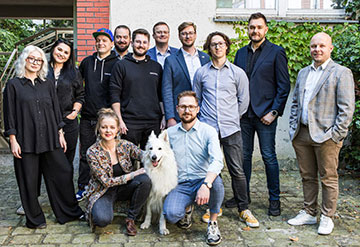
Some of the Gekko Photonics team. [Image: Gekko Photonics]
How do you stay innovative and attract top talent?
We love what we do. That’s the simple answer. We’re excited about the science, about the product, about the challenge. And that energy is contagious.
From the beginning, our small team was built on mutual respect. Two of us came from the technical side, two from the business side. We knew our strengths and trusted each other. And that trust shaped our culture. If someone’s burned out, they rest. If someone needs help, we jump in. It’s a culture of care—and people notice that.
We also give our team freedom. There are no fixed, boring jobs here. Everyone does a mix of things, and everyone can contribute to innovation. We even encourage playful, creative experiments. It keeps us fresh.
What advice would you give to young entrepreneurs in optics and photonics?
Be brave. You don’t need to know everything—you just need to know where to look, and who to talk to. Surround yourself with people who can do the things you can’t. Collaborate. Learn constantly.
And go to meetings. Go to conferences. You learn from the talks, yes—but more importantly, you meet people. Those connections are where the magic happens.
What’s next for you and the company?
Right now, we’re focused on the chemical industry, scaling up and refining our classic Raman-based tools. But we’re not done with SERS and biomedicine. Those projects were very promising—we just didn’t have the resources at the time. We plan to return to them.
We’re also looking at emerging areas like microplastic detection. And we have a whole queue of ideas—new sensors, new devices, new combinations of optical techniques. Our long-term goal is not just to grow one company, but to launch multiple initiatives based on this foundation.
If you could collaborate with anyone—any institution or company—who would it be?
I really enjoy working with both universities and companies. My dream is to be somewhere in between—close enough to the newest science, and close enough to the market to make a difference. I see myself as a translator—of science, of technology, of language.
Whether it’s a university or a multinational company doesn’t matter. What matters is working with brilliant people. That’s the dream.
