

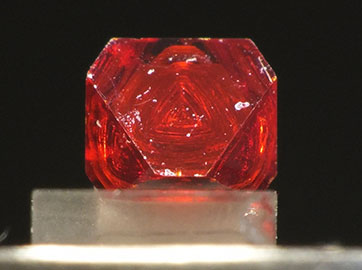
A crystal of the lead-free double perovskite Cs₂BiAgBr₆, for which the scientists observed the generation of shear hypersound pulses under femtosecond laser excitation. [Image: Dirk Schemionek]
Hypersound, which refers to acoustic waves of ultrahigh frequencies in the gigahertz to terahertz range, serves as a powerful tool for nanoscale research with a diversity of potential applications. The field of ultrafast acoustics leverages hypersound to study the elastic properties of nanostructures, dynamically control optical processes and more.
Now, researchers based in Germany and France have successfully used perovskite semiconductors to generate shear hypersound waves through pulsed optical excitation (Sci. Adv., doi: 10.1126/sciadv.adw9172).
“Efficient generation of shear hypersound is highly valuable for advanced electronic and optoelectronic applications operating at sub-THz frequencies,” said study author Dmytro Horiachyi of Technical University Dortmund, Germany. “Because shear waves propagate more slowly than longitudinal waves, they have shorter wavelengths at the same frequency. This enables significantly higher spatial resolution in acoustic imaging, nondestructive testing and nanoscale material probing.”
Generating shear strain
Interest in lead halide perovskites has surged over the past decade, driven by their fast-improving performance in photovoltaic applications. However, despite widespread focus on photonic and optoelectronic uses, fundamental understanding of their optical and mechanical properties remains insufficient. For example, inorganic lead-free double perovskites are attractive as a nontoxic and stable material platform, but deficiencies in charge generation and transport are not well understood.
Horiachyi and his colleagues wanted to explore lead-free double perovskites for ultrafast acoustics, since they possess a soft crystal lattice and multiple structural phase transitions, such as from cubic to tetragonal. In addition, from a practical standpoint, perovskite semiconductors are easy to synthesize with low manufacturing costs, which could lead to the realization of optically driven phononic transducers.
As the strain pulse travels from the surface into the crystal, it modulated the dielectric constant, resulting in oscillations in the reflected probe signal.
The researchers performed femtosecond two-color pump-probe measurements, in which an acoustic strain pulse is generated by a 100-fs pump pulse with photon energy above the band gap where absorption is strong. A second, time-delayed probe pulse monitored its propagation through the transparency window of a lead-free Cs₂AgBiBr₆ double-perovskite single crystal. As the strain pulse travels from the surface into the crystal, it modulated the dielectric constant, resulting in oscillations in the reflected probe signal.
“Typically, only a single oscillation frequency corresponding to a longitudinal hypersound pulse is observed, because laser-induced excitation rarely produces shear waves with appreciable amplitude,” said study author Ilya Akimov, Technical University Dortmund. “The most surprising result in our study was the appearance of a strong shear strain pulse propagating alongside the longitudinal one—a clear indication of efficient transverse hypersound generation.”
Next steps
The researchers further discovered that pronounced shear hypersound emerges only when the crystal is in its tetragonal phase, where the atomic lattice becomes slightly distorted along one axis. In this phase, optical excitation induces an unusual anisotropic lattice response with a nonthermal origin, where the crystal expands along one direction while contracting along another.
“From a fundamental perspective, we are particularly interested in the polarization properties of acoustic waves. By combining orthogonal shear polarizations, it is possible to generate circularly polarized acoustic waves,” said Akimov. “Exploring these chiral and spin-active acoustic phenomena in perovskites—and understanding how they can be controlled optically—will be a major focus of our future research.”
