

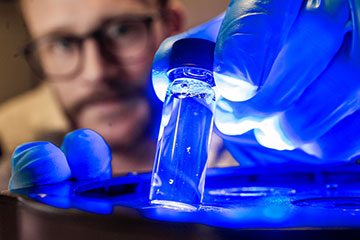
The technique requires no advanced laser setups—visible light from simple LED lamps can drive the polymerization. [Image: Thor Balkhed]
Researchers based in Sweden and the United States have created photopatterned electrodes that can be directly manufactured on different types of surfaces, including glass, textiles and even skin (Angew. Chem. Int. Ed., doi: 10.1002/anie.202517897). The electrodes are made from conductive polymers using a visible-light-induced polymerization process that does not require toxic chemicals or ultraviolet (UV) light.
“As the method works on many different surfaces, you can also imagine sensors built into garments,” said study author Tobias Abrahamsson, Linköping University, Sweden, in a press release accompanying the research. “In addition, the method could be used for large-scale manufacture of organic electronics circuits, without dangerous solvents.”
A safer, simpler process
Abrahamsson and his colleagues work with conducting polymers, unique materials that combine the electronic properties of metals and semiconductors with the mechanical flexibility and processability of plastics. Traditionally, conducting polymers have been produced using methods like chemical oxidative polymerization and vapor-phase techniques, whose drawbacks include environmental concerns, harsh reaction conditions and limited scalability.
In the current work, the researchers introduce a new class of water-soluble organic monomers functionalized with an ionic side chain that polymerize through visible light into conducting polymers. This fully aqueous, visible-light-driven approach produces doped, electrically conductive polymers of high conductivity and volumetric-specific capacitance—without hazardous chemicals, complex instrumentation or damaging UV light.
“I think this is something of a breakthrough,” said Xenofon Strakosas, Linköping University. “It’s another way of creating electronics that is simpler and doesn’t require any expensive equipment.”
Traditionally, conducting polymers have been produced using methods like chemical oxidative polymerization and vapor-phase techniques, whose drawbacks include environmental concerns, harsh reaction conditions and limited scalability.
In-vivo recordings on the skin
As a demonstration of their approach, the researchers successfully fabricated photopatterned electrodes directly on the surface of the skin for in vivo electroencephalography (EEG) recordings on mice. A monomer solution was applied to a precise shadow mask with defined holes and illuminated with a blue LED lamp. After removal of the mask, the well-defined conducting polymer patterns were combined with flexible gold electrodes to enable recordings of brain signals.
The results showed that the presence of photopatterned electrodes improve the interface between electrodes and tissue compared with putting gold EEG electrodes directly on the skin.
“The electrical properties of the material are at the very forefront,” said Abrahamsson. “As the material can transport both electrons and ions, it can communicate with the body in a natural way, and its gentle chemistry ensures that tissue tolerates it—a combination that is crucial for medical applications.”
