

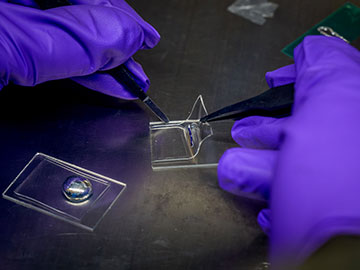
A researcher in Sihong Wang’s molecular engineering laboratory at the University of Chicago tests a prototype of a stretchable OLED screen. [Image: University of Chicago Pritzker School of Molecular Engineering / Jason Smith]
For organic light-emitting diodes (OLEDs) to stretch over irregular or moving surfaces, all three layers of the OLED sandwich must stretch in the same way. However, two of the three structures have had to stay rigid, or else the fluorescent panel fails at tasks such as electron injection.
Now, researchers based at a US university have developed new materials that allow all three layers of an OLED to stretch without losing their electrical and optical characteristics (Nat. Mater., doi:10.1038/s41563-025-02419-z ). The copolymer electron transport layer and the novel thin-film cathode layer enable the stretchable OLED to perform as well as rigid OLEDs with the same emitting layer.
Inside OLEDs
The electron transport layers of conventional OLED sandwiches contain organic small molecules, which don’t stretch properly. Some “stretchable” solar cells have electron transport layers made of organic compounds called fluorenes, which have limited quantum efficiency. Existing “stretchable” conductors that function as cathodes in other devices, such as silicon nanowires and carbon nanotubes, have work functions that are too high for OLEDs.
Sihong Wang and his colleagues at the University of Chicago designed new compounds for both the electron transport and cathode layers of their proof-of-concept OLED display. For the former, the researchers created a stretchable copolymer material. For the latter, the team turned to a counterintuitive technique of making aluminum more brittle instead of less.
Existing “stretchable” conductors that function as cathodes in other devices, such as silicon nanowires and carbon nanotubes, have work functions that are too high for OLEDs.
The new materials
On the molecular level, the electron transport copolymer consists of conductive ring-shaped structures joined by stretchy alkyl chains. The Chicago group tested various versions of the substance with different molar fractions of the alkyl chains to balance out the competing needs of electron transport and sufficient stretchability.
Typical OLEDs have an aluminum cathode, coated with a 1-nm-thick lithium fluoride layer for electron injection. But “normal” aluminum doesn’t stretch.
Instead, the researchers tried a technique called liquid-metal embrittlement: treating the aluminum so that it cracks instead of shatters under stretching conditions. The cracks open up when the material is stretched and close up when the stretching forces are removed. (Think of the bellows of an accordion, with joints that move apart and together.) The aluminum cathode film is bonded to a liquid gallium-indium alloy mixed with aluminum particles.
Toward commercial viability
The team’s resulting stretchable OLED screen requires 3.5 V to power up and posts an external quantum efficiency of 8%—both numbers similar to those of rigid OLEDs made with the same emitter. The team hopes to advance stretchable OLEDs into a commercially viable technology with performance on par with today’s rigid OLEDs, enabling their use across a wide range of smart, human-integrated electronics and humanoid systems.
“Displays are the intuitive application, but a stretchable OLED can also be used as the light source for monitoring, detection and diagnosis devices for diabetes, cancers, heart conditions and other major health problems,” said Wei Liu, a former postdoctoral researcher in Wang’s lab, now with Soochow University, China.
