


Andri Mahendra. [Image: Nicslab]
For the July/August 2025 issue of Optics & Photonics News, we caught up with Andri Mahendra, cofounder and CEO of Nicslab, a fabless photonics company headquartered in the United States with a manufacturing facility in Bandung, Indonesia. Nicslab develops advanced driver and monitoring systems for integrated photonics.
How did your entrepreneurial journey begin? What problem were you trying to solve?
It started during my Ph.D. at the University of Sydney, Australia. I was working on photonic integrated circuits (PICs) for quantum applications. My academic background was in electronics and electrical engineering, and my work was in collaboration with physicists. We were trying to control light on-chip, which is incredibly precise and sensitive work.
At the time, the available tools for controlling PICs were bulky, prohibitively expensive, and difficult to acquire. Even at a major research university, we struggled to get the equipment we needed. That’s when I realized there was an opportunity to build something better—something smaller, cheaper and easier to use.
I started designing circuits that could replace the large, off-the-shelf hardware. I combined hardware and software in a compact format that delivered the performance we needed. It worked—and that success led to the next step. A colleague saw what I was building and asked if I could create a similar system for his lab.
I told him I could do it for US$2,500 and would deliver it in three days. He wired me the money that same night. I spent the next 24 hours building the product at my kitchen table and personally delivered it to him. That experience was the spark. It made me realize I wasn’t just solving a technical problem—I was solving a market need.
What came next? Did you immediately decide to start a business?
Shortly afterward, I pitched the idea to Incubate, the startup incubator at the University of Sydney. They awarded me an equity-free grant of $5,000, which was incredibly encouraging. I used it to build a basic website and started emailing people who fit the profile of that first customer: Ph.D. students, postdocs, professors working on integrated photonics.
I began getting orders—slowly at first, but steadily. The feedback from those early users was essential. I was building a solution for a problem I had experienced firsthand, and I was surrounded by others with the same frustrations. It created a natural feedback loop. But I was still finishing my Ph.D., so I had to temporarily pause the business to focus on writing my thesis.
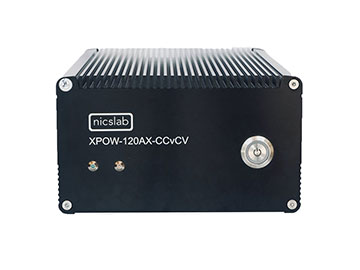
Scalable PIC controller. [Image: Nicslab]
Was it difficult to choose entrepreneurship over academia or industry after graduating?
It was a big decision. After I submitted my thesis, my advisors asked whether I wanted to do a postdoc or go into industry. I told them I wanted to pursue this business full time. I had seen the impact even a small, well-designed tool could have in a research setting. And I believed there was a broader need.
I had to return to Indonesia after graduation because I’d received a government scholarship from the Ministry of Finance, which required me to return and contribute locally. My family helped with some initial capital, and I restarted the business from our garage in Bandung. For two years, that was our “factory”—but we were already serving customers around the world, including the U.S. Army, NTT, Fujitsu, and a number of academic institutions.
Nicslab has grown significantly since then. What does it do today?
We design and build control systems for integrated photonics—drivers, monitors and related tools. Our value proposition hasn’t changed: we make devices that are smaller, more affordable, and easier to use than legacy systems. Most commercial solutions are either overengineered or adapted from telecom or RF applications. Our tools are purpose-built for photonics research and prototyping.
Our customers are mostly researchers working at the cutting edge of photonics, quantum computing, and advanced electronics. Our devices help them do their work faster and more efficiently. We now ship to over 20 countries and have opened offices in Rochester, NY, and Palo Alto, CA, both in the US, in addition to our manufacturing facility in Indonesia.
You mentioned working on electronics as a kid—did you always have that maker mindset?
Yes, absolutely. In junior high school, I built and sold FM radios and tape players to neighbors. I’ve always been passionate about electronics and creating things. My first employee at Nicslab is actually one of my childhood friends—we used to tinker together as kids, and now we’re building advanced photonics tools for researchers around the world. That journey has been incredibly meaningful.
How did joining the Luminate accelerator shape your company’s trajectory?
Luminate was transformative. We joined the 2024 cohort and were honored to be named Company of the Year. The program gave us not just funding, but access to a world-class network of mentors, experts, and investors.
The logistics were tough—traveling between Indonesia and Rochester every month meant long flights and a 12-hour time difference. I personally made 10 trips in one year. But it was worth it. We learned how to scale operations, refine our messaging, and expand in the US market.
Rochester was also a great fit because of its strong optics and photonics ecosystem. Companies like Kodak and Xerox laid the foundation, and there’s now a vibrant community around quantum and integrated photonics. We’ve grown so much thanks to that ecosystem and the people in it.

Nicslab cofounder Anggi Utami and Mahendra accept the US$1 million prize for Company of the Year at the Luminate 2024 finals. [Image: Luminate]
What’s been your biggest challenge as a founder?
Cash flow—especially in the early days. As an engineer, I was comfortable in the lab, solving technical problems. But running a business means understanding people, markets, and finance. Early on, I struggled with that.
A mentor of mine, Simon Poole, introduced me to The Startup Owner’s Manual by Steve Blank. It helped me realize how critical it is to get out of the lab and talk to customers. I set a goal of contacting 300 people a week—through emails, conferences, LinkedIn—to better understand what they needed and how they worked.
Another key learning was asking for payment up front. If someone is willing to pay you now for something they’ll receive in two months, you know you’re solving a real problem. That approach helped us manage cash flow and validated our business model.
How is your technology different from other solutions in the field?
Our devices are designed from the ground up for integrated photonics. That specificity matters. We’re not repurposing telecom gear—we’re building what photonics researchers actually need.
Our products are compact, scalable, and customizable. We’ve developed integrated control circuitry that eliminates the need for bulky discrete components. In 2022, we were granted a U.S. patent, and we’ve since had another accepted. Currently, we’re finalizing eight more inventions.
We’re also fast. Our engineering team is trained in rapid prototyping and IC design. Many of them have won national or international competitions in those areas. We can go from concept to prototype in days, not weeks or months.
How do you maintain that pace of innovation?

[Image: Nicslab]
First, we maintain very close relationships with our customers. We ask for feedback constantly and incorporate it into our product development cycles. Our customers in the US, Japan, Europe, and elsewhere often face similar challenges—but they also have unique needs. We design our systems to be modular and adaptable.
Second, we’ve built a small but highly skilled R&D and prototyping facility in Bandung. We can design, assemble, and test new systems quickly. That gives us a huge advantage.
One of our biggest surprises came when NASA contacted us about using our systems to support exoplanet detection. We didn’t even realize our technology could be applied to that kind of astrophysical research. After a successful deployment, they ordered more, and other agencies followed. That kind of feedback loop helps us innovate faster and stay motivated.
Was there a defining moment in your journey as an entrepreneur?
There have been several. But one that really stayed with me was visiting IBM Watson in Yorktown Heights, New York, US, where I worked as part of my Ph.D. research. I remember sitting near the museum that houses the first memory chip, thinking: “I came from a small village in Indonesia. And now I’m here, contributing to the future of computing.”
That moment made me realize that big dreams are possible. Years later, when we were honored at Luminate, I felt a similar sense of validation. We’ve come a long way—but there’s still so much we want to build.
What advice would you give to young engineers or scientists who are thinking about starting a business?
Don’t stay in your comfort zone. As engineers, we often focus on perfecting the technology without validating the market. The real key is to listen—talk to people, find out what they need, and ask whether they’d pay for a solution.
I always tell other founders: the best validation is a customer willing to pay. If someone pays you $2,500—or $40,000—and is willing to wait several weeks or months, that tells you they truly need what you’re building.
Also, surround yourself with mentors. I was lucky to be guided by people like Simon Poole, Jonathan Fentzke, and Frank Levinson (founder of Finisar). Their experience helped me avoid mistakes and think more strategically.
Finally, be persistent. There will be hard times—supply chain issues, funding challenges, setbacks. But if you’re solving a real problem, and you stay close to your customers, you can survive and grow.
What’s next for Nicslab?
We’re expanding beyond integrated photonics into the broader semiconductor ecosystem. Increasingly, our tools are being used to support advanced electronics applications that demand high-speed, low-power, precision control.
The long-term goal is to become a global leader in tools for advanced semiconductor systems—not just photonics, but the full stack of emerging chip technologies. That means continuing to invest in R&D, expanding our global presence, and attracting the best talent.
We’re excited about what’s next—and grateful to all the people who’ve supported us along the way.
