

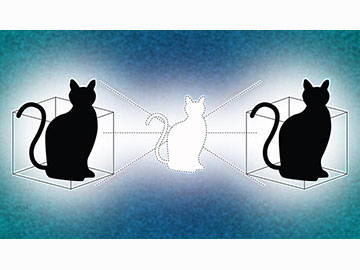
[Image: Illustration by Michael S. Helfenbein/Yale University]
Using a setup with multiple optical cavities tied together with a superconducting artificial atom, physicists at Yale University, USA, have extended one of the most celebrated paradoxes of quantum physics—Schrödinger’s cat, the famous hypothetical feline that, under the framework of quantum superposition, can be both “alive” and “dead” at the same time. It turns out, according to the Yale team, that under the right conditions, the cat can be both alive and dead in two places at once (Science, doi: 10.1126/science.aaf2941). And the result, the researchers suggest, could help pave the way toward redundant encoding for more reliable, fault-tolerant quantum communication and computation.
The paradox of macroscopic superposition
Erwin Schrödinger’s well-known thought experiment envisions an unfortunate cat in a sealed steel box that also contains a radioactive source. If the radioactive material decays, the decay triggers a hammer that “shatters a small flask of hydrocyanic acid” and the cat dies; if the material doesn’t decay, the flask remains shut and the cat lives. Schrödinger noted that, under the so-called Copenhagen interpretation of quantum mechanics, the cat would exist in a “superposition” of states, and would be both alive and dead at the same time until the box was opened and the cat’s probabilistic wave function “collapsed” to one state or the other upon observation.
Schrödinger himself referred to the example as “quite ridiculous,” and intended it as a critique on the view of macroscopic reality implied by the Copenhagen interpretation. But the notion of quantum superposition, even at “mesoscopic” scales above that of a single subatomic particle, has been demonstrated in the laboratory, in particular in experiments in the past two decades involving so-called cat states—distinct coherent states in a single-mode harmonic oscillator. Such experiments have shown superposition in single-mode optical or microwave fields consisting of as many as roughly 100 photons, trapped in single cavities.
Entangling cat states
The Yale research team has now extended the superposition paradox by mixing in a second component of quantum weirdness: entanglement. In the counterintuitive world of quantum physics, the quantum states of physically separated particles can be tied together, such that a local observation of one particle can change the state of another at a distance. Entanglement of single photons and optical modes has become a staple of recent experiments, and an important underlying thread of research in quantum information. The Yale scientists wondered if a complex quantum cat state could be similarly entangled—essentially, if Schrödinger’s cat could exist not only simultaneously in two states, but also in two different boxes.
To find out, the team created a quantum electrodynamics setup consisting of two high-quality 3-D microwave cavities, both electronically tied to a “transmon” superconducting artificial atom, which in turn is coupled to a readout resonator. The cavities—which are capable of storing quantum information for more than a millisecond in superconducting circuits—host cat-state ensembles of microwave photons. The transmon serves both as a way to manipulate the multiphoton states in the two cavities and as a bridge to the monitoring port.
Toward error-correctible quantum computers
Using the apparatus, the team reports, it was able—through a series of logic gates—to deterministically generate a two-mode cat state in the two bridged cavities. The researchers confirmed the accomplishment through an exhaustive analysis of the complex cat state’s full quantum state across more than 100 dimensions of measurement. The complex two-mode state is, in essence, “a Schrödinger’s cat that lives in two cavities” simultaneously—and can also, according to the team, “be viewed as an entangled pair of single-cavity cat states.”
The idea of such a “nonlocal cat” dates back more than two decades, but until now it has resisted an experimental demonstration. Yet the accomplishment of giving Schrödinger’s cat “a second box to play in” is of more than just academic interest. On the path to a reliable quantum computer, finding a way to correct errors without disturbing the information’s delicate quantum state has been cited as an important stumbling block. The team leader, Robert Schoelkopf, noted in a press release that entangled cat states could prove “a very effective approach to storing quantum information redundantly,” and thereby enabling logical operation with quantum bits in an error-correctible manner.
