

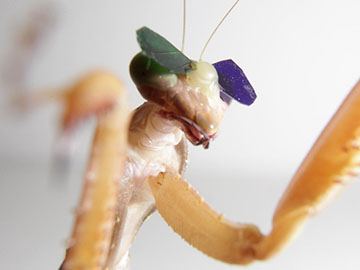
Tiny blue-and-green 3-D glasses allowed the Newcastle team to firmly establish the presence of stereopsis in the praying-mantis subjects. [Image: Newcastle University]
Stereopsis, or 3-D vision, constitutes a core feature of perception in primates and a range of other vertebrates. But so far, it’s known to exist in only one invertebrate—the praying mantis. Digging into the details of mantis 3-D vision has turned out to be a difficult trick, however, as the techniques used for studying stereopsis in humans, cats and owls have proved all but impossible to map to the lanky insects.
Now, a team at Newcastle University, U.K., appears to have cracked the problem. The approach: create a sort of 3-D cinema for praying mantises—complete with tiny 3-D glasses (Sci. Reports, doi: 10.1038/srep18718).
Implications for evolution and robotics
Getting a better handle on mantis 3-D vision isn’t just a whimsical exercise. Because of the vast evolutionary distance between insects and humans, a better understanding of invertebrate stereopsis could help illuminate how 3-D vision evolved in the first place. And grasping the mechanisms of 3-D vision in insects, whose nervous systems are simple relative to those of primates, could cast additional light on how to build 3-D processing and depth perception into robotic or computational systems.
The catch? Up until now, the kind of stereoscopic displays used to study 3-D vision in humans and other vertebrates haven’t been available for the praying mantis. As a result, the evidence that mantises have 3-D vision at all has been largely circumstantial—never mind the prospect of running experiments to obtain a more sophisticated view of the mechanisms behind it. To open up mantis stereopsis for a closer look, the Newcastle group, led by Jenny Read, attempted to build a new 3-D testbed tuned specifically to the details of mantis physiology.
The right glasses for the job
Experiments in 3-D perception in vertebrates typically involve the use of 3-D glasses or other filters; the glasses are designed to present separate images to the subject’s two eyes, and to force the brain to create a virtual 3-D image out of the separate stimuli. So the first step was to fashion something analogous for the mantises. The scientists initially tried a setup using the most common current 3-D technology—which separates the images using circular polarization—but found that this did not work for the mantises.
So the team went “old school,” creating 3-D mantis glasses with lenses of different colors, analogous to the red-and-green glasses used during the 3-D motion-picture craze of the 1950s and 1960s. The tiny glasses—cut out of plastic filters, and using green and blue lenses, as the mantis does not perceive red light well—were affixed with beeswax and rosin to the face of a mantis. Then the insect was placed in front of a specially calibrated monitor, and the show began.
The film fare, while hardly the stuff of Avatar or The Force Awakens, was arguably of more interest to a praying mantis; it consisted of videos of simulated insect prey moving on the monitor screen. The monitor was situated just outside of the mantis’ “catch range,” the distance within which they are known to spring at a target. The team found that the mantises were far more likely to attempt to strike at this simulated prey when the images were set up to project in 3-D—and, thus, to create a virtual image in front of the screen, within the mantis’ catch range—than when the setup only provided a 2-D rendering on the slightly out-of-range flat screen.
The experiments thus provided, according to the researchers, “clear and dramatic proof” of stereopsis in the insects, in contrast to the largely circumstantial evidence available previously. And establishing a platform for presenting the insects with arbitrary virtual 3-D stimuli, the study concludes, should allow researchers to “start to tease apart the algorithms” that underlie invertebrate 3-D perception—a possible plus for future efforts in machine vision.
