

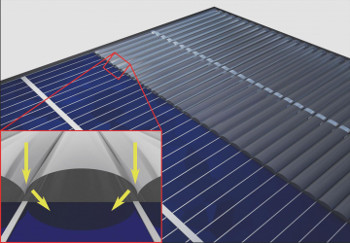
A contact grid “invisibility cloak” would guide sunlight past contact fingers for current removal to the active surface area of the solar cell. [Image: Martin Schumann, KIT]
Scientists at several German research institutes have devised a novel approach for squeezing more efficiency out of solar cells: “cloaking” the cells from the shadows cast by objects on the surface, letting more sunlight through (Optica, doi: 10.1364/OPTICA.2.000850). The team believes that its design, by allowing more solar energy to get to the business end of the cells, could yield as much as a 10 percent increase in efficiency.
Nudging light past “contact shadows”
While solar cells by definition aim to expose as much of their surface area to the sun as possible, they include a necessary superstructure of metallic contact “fingers” and bus bars to extract current and reduce Ohmic resistance losses. These structures inevitably put a small but significant share of the photovoltaic cells in the shade during a solar panel’s daily operating cycle—a phenomenon known in the trade as contact shadowing.
Now doctoral student Martin Schumann of the Karlsruhe Institute of Technology (KIT), along with team leader Carsten Rockstul and colleagues at five other German institutions, have proposed an approach to reducing or eliminating the losses due to contact shadowing: make the contact grid invisible. More specifically, they suggest that, by using metamaterials or freeform dielectric coatings to guide sunlight around the contact grid elements, they can push more sunlight onto the active part of the solar cells, recovering the energy otherwise lost to the shadows.
Transforming the coordinate grid
Drawing on previous work in optical cloaking, the team used computer modeling to develop a coordinate transformation—a distorted Cartesian mesh showing how the direction of an incident light ray would need to be transformed to avoid a contact finger and hit the solar cell surface. The team used two different types of transformations, one of which (optical conformal mapping) resulted in a distribution of refractive indexes that could be mapped into a graded-index surface to achieve the desired cloaking, and the other of which (a simple 1-D linear transformation) could guide the design of a custom dielectric surface using freeform optics.
The research team tried out both approaches by using the calculated parameters to fashion proof-of-principle polymer graded-index structures and dielectric freeform surfaces, which could in principle be used to cloak contact fingers. Next, a 1.5-µm laser light was trained on the fabricated surfaces to test the effectiveness of the cloaking. The freeform surface in particular, the team reports, provides “complete remedy of the shadowing problem,” and could in principle be mass produced.
As a next step, the researchers hope to scale up the proof-of-principle experiments to a real solar cell, to measure the efficiency in real-world conditions. Because contact grids can cover up to a tenth of solar cell surface area, they believe that the technique could boost efficiency by as much as 10 percent.
