

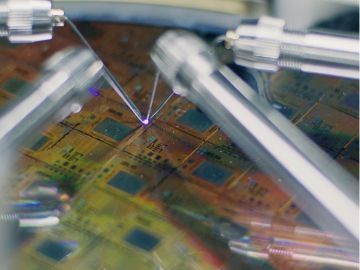
Staera's Lightweight technology. [Image: Staera Semiconductor]
Staera Semiconductor, a startup formerly known as New Silicon Corporation, has emerged from stealth with US$4.6 million in pre-seed funding to commercialize optical interconnect technology designed to move data between chips in AI systems.
Staera is developing optical interconnect technology to address the bandwidth and energy-efficiency limitations of conventional electrical connections between processors and high-bandwidth memory.
The company’s approach focuses on moving large volumes of data efficiently over distances ranging from millimeters to meters, where electrical interconnects face increasing performance challenges."Copper performance plummets over the millimeter-to-meter distances that matter most in AI accelerators, and bolt-on optics add power and complexity,” said Staera CEO Andrew Kim. “We build the light into the chip, the entire optical link inside a chip, so the connection gets smaller, cooler and faster with each generation.”
Staera’s technology, which has been named Lightwire, combines silicon complementary metal-oxide-semiconductor (CMOS) circuitry, gallium nitride (GaN), light-emitting diodes and silicon nitride waveguides on a single wafer. This approach integrates optical links and light sources directly into the silicon platform instead of attaching separate optical components to a chip package.
“We build the light into the chip, the entire optical link inside a chip, so the connection gets smaller, cooler and faster with each generation.”
— Andrew Kim, CEO, Staera Semiconductor
Lightwire is designed to be integrated into the interposers that connect processors and memory devices in advanced chip packages. According to a press release by Stera, the technology could support data rates of 4 to 8 Gbit/s per link, with more than 600 links per millimeter of chip edge. The company is targeting energy consumption below 0.2 pJ/bit, compared with approximately 5 pJ/bit for co-packaged optical links.
Staera also estimates that a Lightwire-based high-bandwidth memory system could achieve data transfer rates exceeding 24 TB/s, while consuming less than 40 W for optical data transmission.
The company reports it has developed processes to integrate GaN LEDs into silicon chips using commercial foundries and reported achieving manufacturing yields of 98% to 99%.
The technology has also attracted industry recognition. Earlier this year, Staera won the IEEE Electronic Components and Technology Conference’s Start-up Competition and was runner-up in the Lam Capital Venture Competition, organized by Lam Research.
The new funding will be used to bring Lightwire technology a step closer to commercialization, expand its team and establish stronger relationships with manufacturing partners and customers.
The investment round was led by Openspace Capital, with participation from SGInnovate, 28 Holdings, In Group, Black Kite Capital and Decimus Technologies.
Staera is targeting 2030 for a commercial release.
